
While pressure equipment is a central part of many gas supply projects, much more is involved than just a single vessel. A complete gas supply project also includes the process design, the pressure piping, the valves and the controls. Installation and the commissioning are also part and parcel of such a project and are followed by the operational time span.
We deliver gas equipment under one EPC contract. Scheme design, equipment production, on-site installation, start-up, staff training, after-sales service, and operation guarantee are all part of a single chain of delivery. One interface, one responsible party, from first sketches to the gas station being in operation.
Tianjin based Okay Energy has over 15 years of experience in designing and manufacturing of gas equipment. We have four main product lines including LNG and cryogenic vaporization equipment, LPG and olefin vaporization equipment, natural gas pressure regulation and metering equipment and gas blending equipment. About 80% of our production is for the Chinese market while 20% is exported to the Middle East, Southeast Asia and Africa.
What One-Stop Gas Equipment EPC Means
For gas equipment, EPC stands for Engineering, Procurement and Construction of a project within a single contract. Supplier develops a design for a project, procures main parts and builds a skid in a workshop, transports and installs it on a customer’s site, starts up and commissions the installed system and hands it over to customer in full working order. Single contract, one responsible party for any parameter or for meeting any deadline.
A multi-supplier split for a project such as this is vessel maker, piping contractor, valve and instrument supplier, control integrator and installer. They all work well in their respective isolation but there are interfaces between them that cause delay and finger pointing. One-stop EPC removes most of these interfaces from the owner’s side.
The acceptance test is also covered by the contract. The outlet pressure and flow, as well as the response time of the skid are checked before handover and the results are recorded by the owner. These test conditions are part of the contract and have been written in the document that was signed and not in an additional side note. This is what makes a single contract on a gas project meaningful.
The One-Stop Service Chain
The chain runs in seven steps:
Scheme design: process flow, heat duty, sizing, and layout matched to the service.
Equipment production: In-house fabrication and testing of the skid.
On-site installation of piping, supports and connections as detailed on the drawing.
Commissioning: The system is filled with media, tested for leaks and put into operation at various conditions.
The operator team receives the necessary training to operate and maintain the system.
After-sales service: support and spares after handover.
Operation guarantee: the system will run as specified.
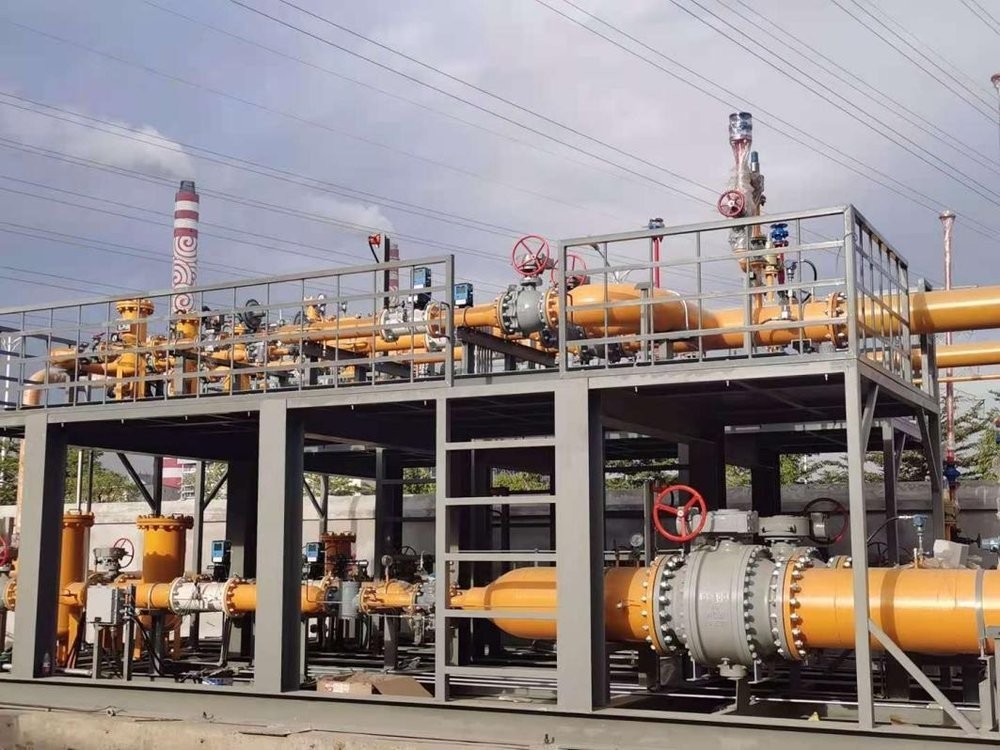
The value is in the handoffs, not in any single step. A critical detail is maintained when design, fabrication and commissioning are all managed by one team as opposed to being handed off to multiple vendors.
Four Product Lines Under One Contract
Most gas plants are a mix of services: a refinery might require LPG start-up gas, a fuel-gas vaporizer and a regulating station; while a city operator may require a peak-shaving unit in LNG form and a gate station. We build all four types of lines in one shop:
LNG and cryogenic vaporization by ambient air, hot-water, and steam vaporizers, plus storage tanks and satellite stations.
Vaporization of LPG and olefins: Electric water-bath, hot-water and steam units from 1,000 kg/h up to 50,000 kg/h.
Natural gas pressure regulation and metering in cabinets for residential applications and in large city gate stations.
Gas blending: multi-gas mixing with calorific value control, including hydrogen-natural gas blending.
One contract, one drawing set, one delivery schedule. All four lines are fabricated under consistent pressure-vessel and control standards.
Using the shared base also has big advantages for spare parts and service: A control cabinet, a regulator or a vaporizer element that is ordered for one line can also be delivered for other lines, which means that the after-sales department only has to work with one parts list instead of numerous vendor catalogs. For a plant in operation for 20 years or so, this consistency is part of the value of one contract.
Manufacturing and Quality Control
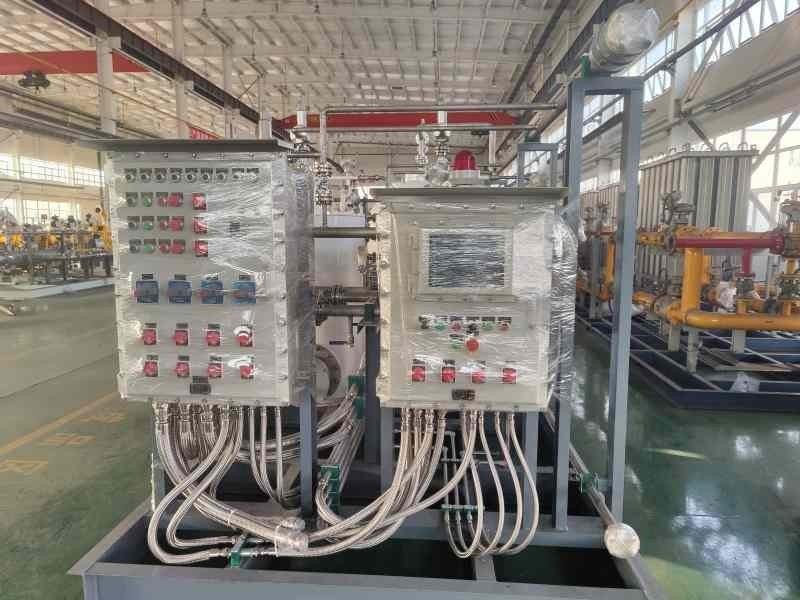
All fabrication is undertaken at Okay Energy’s own factories, with the company completing an expansion of its production base in 2020. The national lab enterprise that it jointly established with Tsinghua University enjoys leading status in the field with over 60 technical patents and 20 software copyrights. The team consists of senior engineers and technicians, with a 20-man strong after-sales service team. On average, the core team members have over 10 years of experience in its relevant field.
At Okay Energy, we hold ASME U and U2 Certificates of Authorization for pressure vessel manufacturing at our Tianjin facility. Our U Certificate (No. 63015) covers pressure vessel manufacturing, while our U2 Certificate (No. 63016) covers Class 1 and Class 2 pressure vessels. These internationally recognized qualifications demonstrate our capability to manufacture pressure vessels in accordance with applicable ASME Boiler and Pressure Vessel Code requirements. They also reflect our commitment to rigorous manufacturing standards, quality control, and safety. For our international customers, these certifications provide greater confidence in the quality, reliability, and compliance of the pressure vessels we manufacture.
The production of each and every individual skid goes through a 16 step quality control process, starting from contract to technical review and then on to the preliminary design, user check of drawings and then the production process itself, in-process inspection (NDT etc.), finished goods inspection and finally shipping. As one of the very first companies in China’s gas industry to be issued with both a manufacturing license for pressure-piping components and an installation license for pressure-piping, Okay Energy was granted these in 2011.
Track Record at Home and Abroad
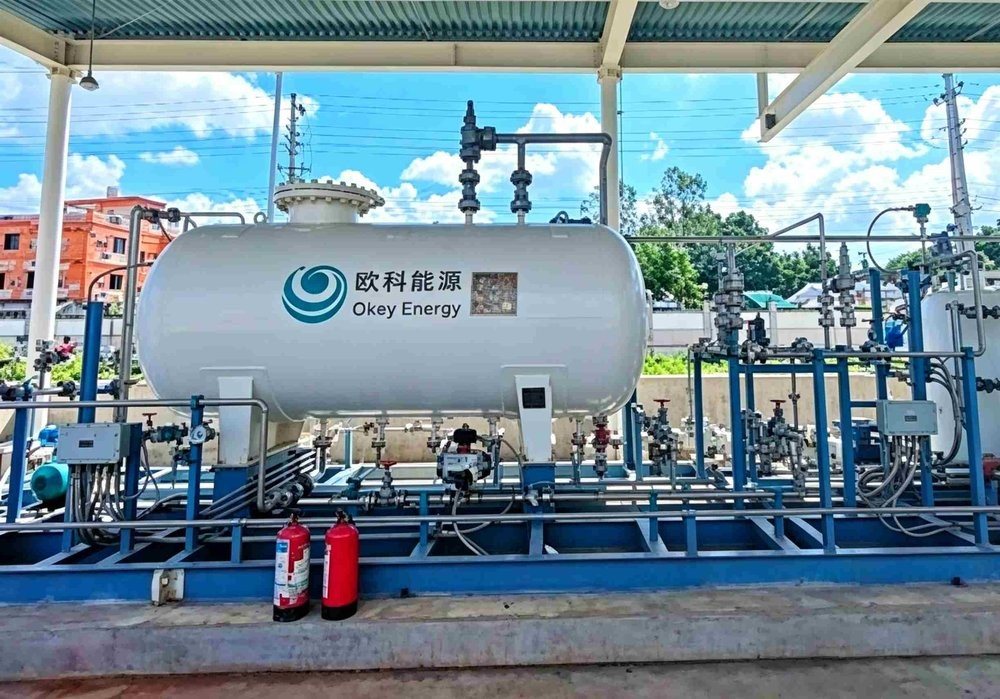
Our scope of work covers the full gas chain – from LNG to Natural Gas, LPG vaporization. Our LNG experience includes storage and vaporization areas for Siam Gas and Petrochemical in Thailand (30/60 m3, 450/600 Nm3/h), a CNOOC project (80 m3, 4,000 Nm3/h) as well as a 200 m3 coal-mine inerting system for CHN Energy (5,000/6,000 Nm3/h). A PipeChina city gate station for Natural Gas is operating at 800,000 Nm3/h. For LPG vaporization we deliver systems for ExxonMobil (10,000 kg/h) as well as for Zhejiang Petroleum and Chemical (25,000 kg/h).
Our Export work covers countries such as Jordan, Brunei, Thailand, Myanmar, Bangladesh, India, Indonesia, Iran, Ghana, Morocco and Nigeria. Whether a project is local or abroad, the same team of engineers design, build, install and commission gas systems of different sizes.
How to Evaluate a Gas Equipment EPC Partner
Before signing, check six things:
License and qualification for manufacturing of pressure vessels and pressure piping, as well as for their installation.
EPC scope: What does the contract include, design and procurement or just the supply of equipment?
Single point of responsibility: one party responsible for the whole system.
Quality system: documented process, inspection, non-destructive testing, airtight testing.
Track record in service to your size: vaporization, regulation, or metering.
After-sales: warranty, spare parts and training of the operators are included in the contract.
An EPC partner should be able to demonstrate all six of these prior to the release of the first drawing.
Conclusion
Our One-stop gas equipment EPC service transfers the risks of design, fabrication, installation and commissioning to one contract holder and party. Our four product lines and 16 step quality process can be executed under our One-stop service model, with references in LNG, LPG and natural gas products and applications.
Contact Okay Energy for a scheme design or formal quotation for all necessary equipment or a full EPC proposal for your international project. For international projects Qiu Yunong (Samuel) can be contacted on +86-18630851982 or 18630851982@163.com.
FAQ
What does one-stop gas equipment EPC include?
Our packages cover scheme design, plant manufacture, site installation, commissioning, training of personnel, after sales service and operation guarantee under one contract with one responsible party for the complete system.
Can Okay Energy cover more than one gas product line in one project?
Yes. LNG and cryogenic vaporization, LPG and olefin vaporization, natural gas regulation and metering, and gas blending can all be supplied within one project and fabricated in the same shop.
What quality and licensing back the equipment?
All skids are processed through a 16 step quality control process which includes non-destructive testing, strength testing and airtight testing. Okay Energy has a manufacturing license for pressure-piping components and an installation license for pressure piping, as well as ISO9001:2015, ISO14001:2015 and OHSAS18001:2007 certifications and over 60 technical patents.
What after-sales and warranty come with the project?
The 7-day trial period comes to an end after which the equipment is covered by a 12-month warranty. Personnel training and after-sales support are included in our comprehensive one-stop service offer.