
Steam-heated vaporizers are not automatically the preferred solution for every liquefied-gas vaporization project. The appropriate technology depends on the heating medium, vaporization capacity, operating conditions, plant utilities, and overall project requirements. Electric and ambient systems have widened the selection range, so the appropriate selection depends on whether the heating medium, required vaporization capacity, operating conditions, and plant utilities make steam heating the right engineering choice.
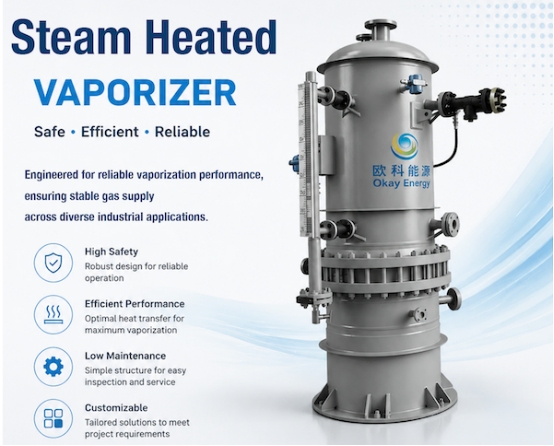
At Okay Energy, our Steam Heated Vaporizer is designed for LPG, LNG, and other industrial gas applications, with customized capacity and skid-mounted or standalone installation. The basic vaporization principle is shared across liquefied gases, but the thermal design, material selection, pressure rating, heat-transfer requirements, and outlet conditions must be engineered for the specific medium.
Why Steam Heating Has Long Been Used for Industrial Vaporization
Existing Steam Utilities Made Large-Scale Heating Practical
In facilities where a reliable steam utility is already available, steam can be integrated into the vaporization system without requiring a separate primary heating source. In these plants, steam can be integrated into a vaporization system without creating a completely separate heating concept.
If a plant already has reliable steam with sufficient pressure, temperature, flow capacity, and suitable steam quality, the existing utility system can be integrated into the vaporization package. The design should also consider steam pressure control, condensate removal, heat-transfer requirements, and utility availability.
Continuous Industrial Loads Need a Dependable Heat Source
Fuel-gas networks, boilers, chemical processes, and LNG or LPG stations may require gas supply for long operating periods. Okay Energy’s Steam Heated Vaporizer is designed for continuous industrial operation and can be integrated into LPG vaporization systems, LNG stations, power-plant gas supply, chemical processes, and industrial gas networks. Its capacity is customized rather than limited to one fixed size.
Why Steam-Heated Vaporizers Still Matter Today
Steam heating may become an attractive option for high-capacity, continuous-duty vaporization when sufficient steam capacity is already available at the site. A small intermittent vaporization system and a high-capacity process vaporization system have very different utility and heat-duty requirements. At higher loads, engineers must evaluate total heat duty, operating hours, electrical capacity, steam availability, process stability, and redundancy instead of comparing vaporizer types by name alone.
A 50 t/h Project Shows Why Steam Heating Still Has a Role
A recent Okay Energy project provides a useful example. For a DMC purification project, we supplied a customized 50 t/h LCO2 vaporizer using circulating water heated by steam, model KVSW-CO2-50000 kg/h, designed to vaporize 50,000 kg/h of liquid CO2. The specified inlet pressure was 4.0 MPa, inlet temperature was -35°C, outlet temperature was 20°C, maximum pressure drop was ≤0.1 MPa, and heat duty was approximately 5,250 kW.
The system used circulating water supported by steam heating, with a specified 350 t/h circulating-water flow and 10.5 t/h steam flow at 0.55 MPa and 156°C. Outdoor vertical installation and DCS integration were also required. The project illustrates why vaporizer sizing should not be based on flow rate alone; pressure, temperature, heat duty, control, and allowable pressure drop also affect the design.
When Is Steam Heating Still the Right Choice?
A steam-heated vaporizer deserves serious consideration when:
The facility already has a reliable steam source.
Vaporization demand is large and relatively continuous.
Stable heating is required independent of ambient weather.
Adding a large electrical heating load is undesirable.
The vaporizer must integrate with an existing plant utility network.
Outlet temperature, pressure drop, and process continuity require controlled engineering.
For Okay Energy projects, nominal capacity is only one sizing input. Gas type, inlet and outlet conditions, installation constraints, and control logic should be reviewed together.
When Should You Consider an Alternative?
Steam is not automatically the best choice when no steam infrastructure exists. Installing a boiler, steam piping, water-treatment equipment, condensate handling, and controls only for one vaporizer may increase project complexity.
For sites with sufficient electrical capacity, an Electric Water Bath Vaporizer can provide another controlled heating route. Okay Energy’s design uses electrically heated water and stainless-steel heat-exchange coils, with automatic water-bath temperature control, a gas-liquid separator, and safety interlocks. The standard capacities listed on the product page range from 50 to 1,000 kg/h, while project-specific capacity can also be evaluated.
Ambient-air vaporization may also be considered where climate, installation area, and duty pattern are suitable. However, its performance and practical capacity should be evaluated against ambient temperature, site conditions, required duty cycle, and the possibility of reduced heat-transfer performance under unfavorable environmental conditions.
Steam vs. Electric vs. Ambient: Think in Terms of Project Fit
The appropriate engineering approach is to select the vaporization technology according to the process duty and available utilities.
What Engineers Should Specify Before Selecting a Steam-Heated Vaporizer
Before requesting a vaporizer quotation or completing the equipment specification, the project team should define more than a required flow rate. Useful project data includes:
Gas type and composition.
Normal, minimum, and peak vaporization flow rate.
Liquid inlet pressure and temperature.
Required gas outlet pressure and temperature.
Allowable pressure drop.
Available steam pressure, temperature, and flow.
Continuous or intermittent duty cycle.
Installation environment and material requirements.
PLC, DCS, alarm, shutdown, and redundancy requirements.
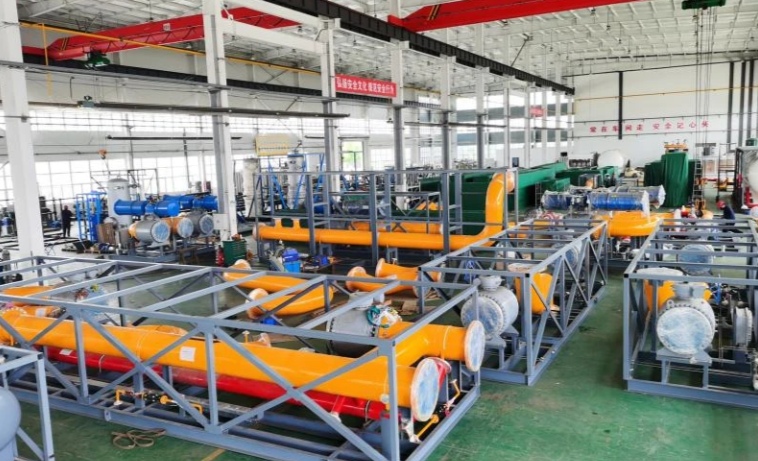
Okay Energy’s Steam Heated Vaporizer is listed for LPG, LNG, and industrial gases, with steam as the heat source, customized vaporization capacity, ASME/international-standard design options, and skid-mounted or standalone installation. We also provide customized vaporization solutions covering design, manufacturing, testing, and complete skid-mounted gas-supply systems.
Okay Energy can also integrate vaporization equipment into skid-mounted gas supply systems and project-specific engineering packages.
So, Are Steam-Heated Vaporizers Still the Industry Standard?
Not as a universal standard, but it remains an established technology for specific industrial applications. Steam heating remains a strong option for large, continuous industrial vaporization when the site already has suitable steam infrastructure and the process benefits from controlled heat input.
For smaller, intermittent, or utility-constrained installations, electric or ambient alternatives may provide a better overall project fit. The appropriate selection principle is to evaluate the complete process and utility requirements rather than the heating method alone. Vaporizer selection should be based on the complete process and utility requirements rather than on the heating method alone.
At Okay Energy, we evaluate the process fluid, vaporization capacity, pressure, temperature, heat source, installation requirements, and control requirements together. Contact us with your process data to discuss whether a Steam Heated Vaporizer or another vaporization solution better fits your project.
FAQ
Q: Are steam-heated vaporizers becoming obsolete?
A: No. They are no longer the only widely used vaporization technology, but they remain useful for large and continuous industrial gas duties where reliable steam is already available. Suitability depends on site utilities, heat duty, gas conditions, operating hours, and integration requirements.
Q: Is a steam-heated vaporizer always cheaper to operate than an electric vaporizer?
A: Not necessarily. Operating cost depends on steam and electricity prices, boiler efficiency, operating hours, maintenance, and whether steam infrastructure already exists. A plant using available steam can have a very different cost structure from a site that must build a new steam system.
Q: What information is needed to size a steam-heated vaporizer?
A: Key information includes the gas medium, normal and peak flow, liquid inlet pressure and temperature, required outlet pressure and temperature, allowable pressure drop, available steam conditions, duty cycle, installation environment, materials, applicable standards, and control requirements.
Q: Can a steam-heated vaporizer be used for both LPG and LNG?
A: Okay Energy lists its Steam Heated Vaporizer for LPG, LNG, and other industrial gases. However, the final configuration must be engineered for the specific medium, pressure, temperature, vaporization load, materials, and downstream process requirements.