
In the competitive world of industrial manufacturing, the reliability of energy supply directly affects production efficiency, operational stability, and overall project performance. For facilities relying on Liquefied Petroleum Gas (LPG), the challenges are multifaceted: fluctuating propane-butane ratios, inconsistent gas quality, and challenges caused by LPG supply interruptions. As a specialized manufacturer of industrial energy solutions, we at Okay Energy understand that selecting an LPG Mixing Skid System is not merely a procurement task; it is an important engineering decision that affects operational continuity and fuel management efficiency. With extensive experience in industrial energy projects, Okay Energy provides customized LPG Mixing Skid Systems and skid-mounted gas solutions for customers worldwide.
Assessing LPG Blending Capacity Requirements
Determining Capacity Based on Storage and Distribution Requirements
The maximum flow rate of an LPG Mixing Skid System is not determined by burner or boiler consumption. Instead, engineers evaluate the customer’s LPG storage capacity, commercial supply requirements, and required filling schedule. Instead, engineers evaluate the customer’s LPG storage facilities, commercial supply requirements, and operational schedule. For example, if a project includes ten LPG spherical tanks with a capacity of 2,000 m³ each, the required mixing capacity depends on how quickly the customer expects to fill these tanks and prepare the LPG product for storage or distribution.
Scalability for Future Industrial Expansion
Industrial projects are rarely static. When selecting a Skid Mounted LPG System, you should consider your facility’s growth projections for the next five to ten years. A modular design is crucial here. At Okay Energy, our systems are engineered for flexibility. By utilizing a modular “skid-mounted” approach, we allow users to expand their capacity by adding additional skids or upgrading specific components, such as higher-capacity Automatic regulating valves, without a complete overhaul of the existing infrastructure. This modular design allows easier system expansion and reduces future modification requirements.
Defining Precise Propane-Butane Blending Ratios
Customized Blending Based on LPG Inlet Conditions
LPG blending performance is affected not only by propane-butane ratio but also by inlet temperature and pressure conditions. Okay Energy designs customized blending solutions according to the actual characteristics of incoming LPG streams to ensure stable mixing performance and maintain the required product specifications.
Impact of Gas Composition on LPG Product Quality
LPG is primarily composed of propane and butane, and the ratio directly affects vapor pressure, calorific value, density, and final LPG product specifications. If the propane-butane ratio varies significantly, the finished LPG product may fail to meet the required calorific value, vapor pressure, or product specifications for different markets and applications. To solve this, we integrate Industrial Gas Blending/Calorific Value Control and Management technology into our skids.
Real-Time Adjustments for Consistent Calorific Value
Precision is the hallmark of a high-quality Propane Butane Blending System. Modern industrial projects require more than just a static mix; they require real-time ratio control and automatic flow adjustment. Our systems utilize high-accuracy Mass Flowmeter or Gas Turbine Flow Meter hardware to monitor each gas stream. These inputs are processed by our control logic to automatically adjust flow rates in real time to maintain the target blending ratio. This helps maintain consistent LPG composition and calorific value.
Reducing BOG Generation Through Optimized Blending
LPG inlet temperature and pressure conditions directly affect vaporization behavior during storage and transfer. By designing the blending process according to actual inlet parameters, Okay Energy helps optimize LPG handling conditions, reduce excessive Boil-Off Gas (BOG) generation and minimize energy losses during LPG storage and transfer.
Selecting the Optimal Level of Automation
Advantages of Integrated PLC Control Systems
Compared with manual operation, automatic control systems provide more accurate and stable LPG blending performance. For a reliable industrial project, you should insist on an Automatic LPG Mixing Skid System equipped with a sophisticated PLC Control System. Our automation packages do more than just mix gas; they manage the entire process, including flow metering, ratio control, and pressure regulation. By reducing human intervention, you minimize the risk of operational errors and ensure that the system reacts instantly to changes in inlet conditions and operating parameters.
Remote Monitoring and Digital Data Acquisition
Digital monitoring and communication functions help operators track system performance and improve operational management. When choosing a manufacturer, look for systems that offer PLC + DCS Communication capabilities. We provide remote monitoring interfaces that allow your engineers to track flow rates, pressures, and system status from a central control room through HMI, SCADA, or DCS communication interfaces. This digital transparency is essential for predictive maintenance and helps in optimizing fuel consumption over the long term, ultimately lowering your operational costs.
Prioritizing Safety and Compliance Standards
Essential Explosion-Proof Design for Hazardous Zones
Safety is a critical consideration in LPG system design. Any LPG Mixing Skid System you purchase must be designed for hazardous environments. At Okay Energy, all our electrical components, including explosion-proof electrical components and safety devices, are designed according to project requirements. Our manufacturing processes follow international quality management standards.
Multi-Stage Pressure and Level Protection Systems
A robust safety architecture must include redundant protection layers. Your chosen system should feature a Pressure Protection System that includes safety relief valves and an Emergency shutdown function. Furthermore, for systems incorporating LPG storage or buffer vessels, a reliable level monitoring system is required. We use Magnetic level gauge technology paired with remote level transmitters to provide real-time data to the PLC. If a liquid level or pressure exceeds safe parameters, the system will automatically initiate a protective shutdown, preventing accidents before they occur.
Evaluating Installation and Environmental Factors
Benefits of Modular Skid Mounted LPG Systems
Traditional on-site construction of gas facilities is often plagued by delays and quality control issues. This is why we use skid-mounted LPG systems. By assembling and testing the entire unit—including the Two-Stage Filtration System (Cyclone + Precision Filter) and LPG pressure regulating and control components—in our factory, we ensure that every connection is secure and every sensor is calibrated.
Weatherproofing for Extreme Operating Conditions
Industrial projects are often located in harsh environments, from the humid tropics of West Africa to the cold climates of Northern Asia. Your LPG Blending System must be built to endure. Our skids are designed with a Design Temperature as low as -29℃ and utilize high-quality materials capable of withstanding corrosive atmospheres.
Full Life-Cycle Support from Okay Energy
Expert Consultation and Customized Skid Design
We believe that every project is unique. Our process begins with a comprehensive project consultation and engineering evaluation to understand each customer’s technical requirements. We don’t just sell off-the-shelf products; we provide customized LPG Engineering Solutions. From the initial design of the LPG Mixing Skid System to the selection of the right Pressure Regulator & Shut-off Valve, we align our engineering with your performance goals.
Professional Installation Guidance and Global Support
The relationship between Okay Energy and our clients includes post-delivery support. We provide one-stop services that include on-site installation guidance and equipment commissioning. Our professional after-sales team provides installation guidance, commissioning support, and technical assistance throughout the project lifecycle. Whether you are in Ghana, Saudi Arabia, or Southeast Asia, we ensure that your technical team is trained and that your equipment operates at peak efficiency for years to come.
Case Study: Ghana’s 20,000 kg/h Blending Excellence
Overcoming Regional Energy Infrastructure Challenges
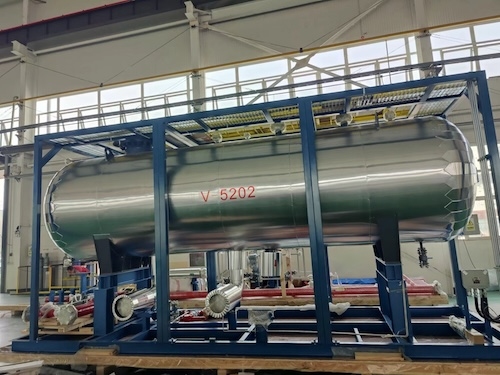
In the Ghana LPG Mixing Skid System Project, our client faced a critical need for a stable LPG supply for a regional industrial distribution network. The local infrastructure required a system that could handle large volumes while maintaining a precise propane-butane ratio despite varying supply qualities. We stepped in as a professional LPG Mixing Skid Manufacturer in China to provide a turnkey solution that addressed these volatility issues.
Achieving Stability with High-Capacity Mixing Solutions
The Ghana LPG Mixing Skid System Project was designed with a maximum capacity of 20,000 kg/h based on the customer’s LPG storage requirements and commercial distribution plan. The required flow rate was determined by evaluating how quickly the customer’s storage tanks needed to be filled rather than by the consumption rate of downstream equipment. The capacity was calculated to ensure the required propane-butane blending volume could be completed within the customer’s expected filling schedule. This project serves as a benchmark of our capability to manufacture “Specialized and Sophisticated” equipment that meets the high-capacity and high-safety demands of global energy projects.
Conclusion
Choosing the right LPG Mixing Skid System is an important decision for your industrial project’s future. It requires a partner who can balance technical precision with rugged reliability. At Okay Energy, we provide more than just equipment; we provide a complete energy security package. From evaluating LPG storage requirements and blending capacity to implementing advanced Automatic LPG Mixing Skid System technology and providing life-cycle support, we are dedicated to “Building a Century-Long Legacy” through engineering excellence. By choosing Okay Energy, you are choosing a partner trusted by industrial customers worldwide for reliable gas equipment solutions.
Contact Okay Energy today for a customized consultation and discover how our Automatic LPG Mixing Skid System can optimize your LPG blending, storage, and distribution operations.
FAQ
Q: What factors determine the capacity of an LPG Mixing Skid System?
A: The capacity of an LPG Mixing Skid System is mainly determined by LPG storage capacity, commercial production requirements, and the expected filling time. Engineers evaluate factors such as storage tank volume, LPG sales demand, inlet LPG conditions, and required blending rate. For example, a system serving multiple 2,000 m³ LPG spherical tanks may require a higher blending capacity depending on the customer’s target filling schedule.
Q: Why is a PLC control system necessary for LPG blending?
A: A PLC Control System is essential for precision and safety. It monitors high-accuracy Mass Flowmeters and adjusts Automatic regulating valves in real-time to maintain a constant propane-butane ratio. This ensures accurate propane-butane ratio control, consistent LPG composition, and stable product quality during continuous operation.
Q: What kind of safety protections are included in your LPG skids?
A: Our systems feature multi-layer safety architectures, including Explosion-proof PLC cabinets, Pressure Protection Systems with safety relief valves, and Level Control Systems utilizing Magnetic level gauges. These systems are designed to trigger an emergency shutdown automatically if any parameters deviate from safe levels.