
Selecting a liquid CO₂ vaporizer by nominal kg/h capacity alone can lead to a poor process match. For large industrial applications, correct sizing should consider peak CO₂ demand, inlet and outlet conditions, heat duty, pressure drop, heating source, and operating profile together.
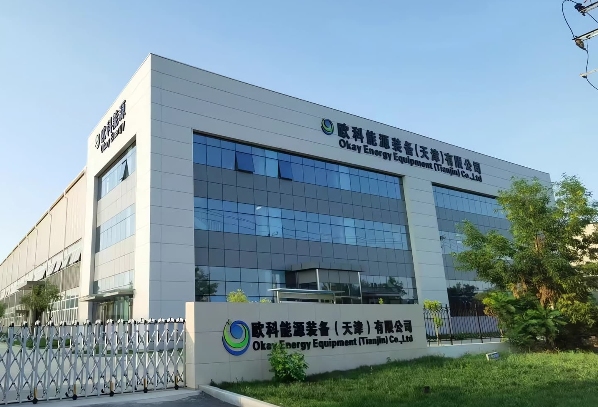
At Okay Energy, we treat vaporizer selection as an engineering task rather than a simple capacity match.
How Do You Size a Liquid CO₂ Vaporizer?
A practical sizing process has seven steps:
- Determine normal and peak CO₂
- Confirm LCO2 inlet pressure and temperature.
- Define required gas outlet pressure and temperature.
- Calculate the required heat duty.
- Check allowable pressure drop.
- Select a heating method that matches the heat load and site utilities.
- Add a suitable operating margin and decide whether redundancy is needed.
Vaporization capacity in kg/h is the starting point, not the complete equipment specification.
What Information Do You Need Before Sizing a CO₂ Vaporizer?
| Required Data | Why It Matters |
| Normal and peak CO₂ flow | Defines typical and maximum load |
| Inlet pressure and temperature | Defines the LCO₂ inlet state |
| Outlet pressure and temperature | Defines the required gas condition |
| Allowable pressure drop | Protects downstream pressure |
| Operating profile | Defines continuous, intermittent, or batch duty |
| Heating utility | Influences vaporizer configuration |
| Site conditions | Affect installation and thermal performance |
Step 1 — Size for Peak CO₂ Demand, Not Average Consumption
The design basis should include normal, design, maximum and minimum CO₂ flow rates, together with the required turndown range. Startup, shutdown, batch operation and other transient conditions should also be considered where applicable. Selecting only for average consumption can leave insufficient vaporization capacity at peak demand.
Operating profile also matters. Okay Energy’s Air Ambient Vaporizer uses ambient air as the heat source, so site conditions must be considered when evaluating usable capacity.
Step 2 — Define the LCO2 Inlet and Gas Outlet Conditions
Mass flow defines the required vaporization rate, while pressure and temperature establish the thermodynamic state of the CO₂ stream.
Confirm both LCO2 inlet pressure and temperature, then specify the gaseous CO₂ outlet pressure and temperature required downstream. The vaporizer must deliver gas in a condition suitable for the next process stage.
In Okay Energy’s 50 t/h project, LCO2 enters at 4.0 MPa and -35°C and exits at approximately 20°C. These are project-specific values rather than universal sizing conditions.
Step 3 — Calculate the Required CO₂ Vaporizer Heat Duty
For preliminary sizing, the required process-side heat duty can be estimated from the enthalpy balance:
Q̇ = ṁ(CO₂) × (h_out − h_in)
where h_in and h_out are the specific enthalpies of CO₂ at the specified inlet and outlet states. For high-pressure CO₂ service, the calculation should use thermodynamic property data at the actual operating pressure and temperature rather than applying a simple mCpΔT approximation.
This is why two projects with the same kg/h flow may require different heat-transfer duties: different pressure and temperature conditions change the enthalpy difference.
Step 4 — Check Allowable Pressure Drop
Excessive pressure loss can reduce pressure available downstream. Flow velocity, tube dimensions, heat-exchanger geometry, valves, fittings, and piping all contribute, so heat transfer must be balanced with hydraulic performance.
For the 50 t/h project, the maximum specified pressure drop is ≤0.1 MPa at a design vaporization capacity of 50,000 kg/h.
Step 5 — Choose the Heating Method Based on Heat Load and Site Conditions
After the thermal duty is understood, select a heating method that fits both the load and available utilities.
| Heating Method | Main Design Considerations | Typical Application |
| Ambient air | Ambient temperature, humidity, frost formation, operating duration | Sites with suitable ambient conditions |
| Electric water bath | Electrical capacity, heat duty, temperature control | Sites without suitable steam/hot-water utilities |
| Hot-water bath/circulation | Water temperature, circulation rate, heat duty | Continuous industrial duty |
| Steam-heated | Steam pressure, steam temperature, condensate handling, heat duty | Large continuous industrial applications |
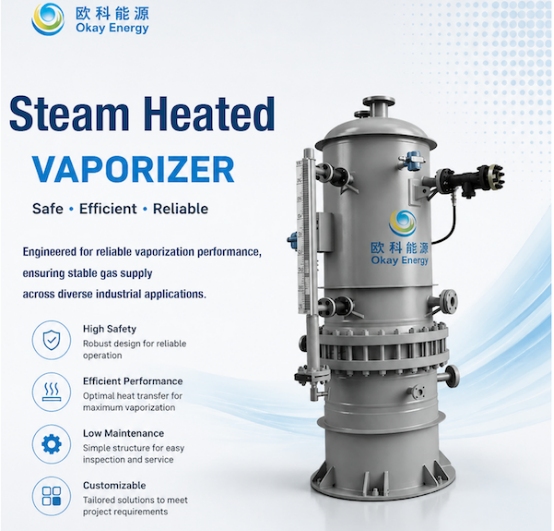
Okay Energy offers Air Ambient Vaporizer, Electric Water Bath Vaporizer, Water Bath Vaporizer, and Steam Heated Vaporizer solutions. Okay Energy also provides customized steam-heated vaporization systems for large industrial applications, with the final capacity and utility requirements determined by the project process conditions.
Step 6 — Add the Right Operating Margin
A design margin can accommodate peak demand, utility variation, or future expansion, but no single percentage suits every project.
Depending on required availability, a project may use one full-capacity unit, parallel vaporizers, or a duty/standby arrangement. The choice should reflect turndown, maintenance strategy, and the consequences of CO₂ supply interruption.
Worked Example — A 50,000 kg/h LCO₂ Vaporizer
Okay Energy supplied the customized KVSW-CO2-50000 kg/h vaporizer for a DMC purification project.
| Parameter | Project Value |
| Vaporization capacity | 50,000 kg/h |
| LCO₂ inlet pressure | 4.0 MPa |
| LCO₂ inlet temperature | −35°C |
| CO₂ outlet temperature | 20°C |
| Heat duty | 5,250 kW |
| Maximum pressure drop | ≤ 0.1 MPa |
| Heating medium | Circulating water + steam |
The vaporizer is configured for DCS integration and vertical outdoor installation. The 50,000 kg/h flow rate alone does not fully define the vaporizer design. The equipment must be evaluated against thermodynamic conditions, heat duty, allowable pressure drop, heating utility, installation requirements and control requirements.
Liquid CO₂ Vaporizer Sizing Checklist
Before requesting final sizing, confirm:
- normal and peak CO₂flow;
- inlet pressure and temperature;
- required outlet pressure and temperature;
- maximum allowable pressure drop;
- available heating utility;
- operating hours and minimum site temperature;
- redundancy, installation, and control requirements.
Common CO₂ Vaporizer Sizing Mistakes
Common mistakes include selecting by kg/h alone, using average instead of peak demand, ignoring inlet or outlet conditions, overlooking pressure drop, or choosing a heating method before reviewing heat duty and site utilities.
A properly sized industrial CO₂ vaporizer is a process-specific heat-transfer system, not simply a catalogue unit with a nominal flow rating.
What Should You Send a Vaporizer Manufacturer for Final Sizing?
Provide the gas medium, normal and peak flow, inlet pressure and temperature, required outlet conditions, allowable pressure drop, available heating utility, operating schedule, site environment, and control requirements.
At Okay Energy, we work across R&D, design, production, industrial gas equipment, and EPC engineering services. Our workflow includes technical review, preliminary design, drawing confirmation, material inspection, and production quality control. For customized vaporizer projects, we can connect process-data review with thermal design, mechanical design, fabrication, inspection, and delivery.
If you are planning a high-capacity liquid CO₂ vaporization system, send your process conditions to Okay Energy for preliminary vaporizer sizing and configuration evaluation. Contact us today to learn more.
FAQ
Q: How is liquid CO₂ vaporizer capacity calculated?
A: Start with normal and peak CO₂ mass flow, then evaluate the inlet and outlet states to determine heat duty. Capacity should also be checked against pressure drop, heating-source availability, and operating profile.
Q: Can I size a CO₂ vaporizer based only on kg/h?
A: No. Mass flow determines the required vaporization rate, but final sizing also requires the inlet and outlet thermodynamic states, heat duty, heat-transfer area, allowable pressure drop, utility conditions, turndown and operating profile.
Q: How does ambient temperature affect CO₂ vaporizer capacity?
A: It is especially important for an ambient-air vaporizer because surrounding air supplies the heat for vaporization. Lower ambient temperatures reduce the available thermal driving force, so climate and operating duration should be evaluated.
Q: When should multiple CO₂ vaporizers be used?
A: Multiple units may be useful when a project requires redundancy, wider turndown, maintenance flexibility, or staged capacity. The arrangement should follow process availability requirements rather than a fixed rule.