
LNG vaporizer sizing should begin with the required peak natural gas flow rate and the corresponding design operating conditions, rather than being determined from LNG storage tank volume alone. A practical design should also consider LNG inlet conditions, required outlet pressure and temperature, minimum ambient temperature, operating hours, load variation, and redundancy. For ambient-air systems, climate and frosting can affect available heat-transfer performance, so capacity should be checked against real site conditions rather than nameplate flow alone.

Effects of Undersizing and Oversizing an LNG Vaporizer
The undersized LNG vaporizer might be unable to deliver the desired level of gas flow, temperature, and pressure downstream under full load conditions. In case there is insufficient capacity for vaporization or the issue of liquid carryover, the performance of pressure regulation and combustion will suffer. If the sizing is done considering the average gas consumption, it may cause a lack of sufficient capacity during start-up or other peak load situations.
Over-sizing does not mean it is always a good idea. It adds up costs and increases complexity without contributing any additional reliability benefits.
How to Size an LNG Vaporizer Step by Step
Step 1: Determine Normal and Peak Natural Gas Demand
Collect the normal and maximum gas consumption of all downstream users. Identify short-duration peaks caused by startup, burner ignition, batch operation, or simultaneous equipment use.
Average consumption should not be treated as design capacity by default. If a plant normally consumes 400 Nm³/h but reaches a higher rate during startup, the vaporizer must be checked against that peak condition.
Step 2: Confirm LNG Inlet Conditions
LNG composition, inlet pressure, inlet temperature, and storage-tank operating conditions affect vaporization duty. These values should come from the actual project specification rather than a universal conversion factor.
When converting liquid consumption into gas flow, use project-specific LNG properties and reference conditions.
Step 3: Define Required Gas Outlet Conditions
The downstream process needs gas at the correct pressure and temperature, rather than relying solely on the required flow rate.
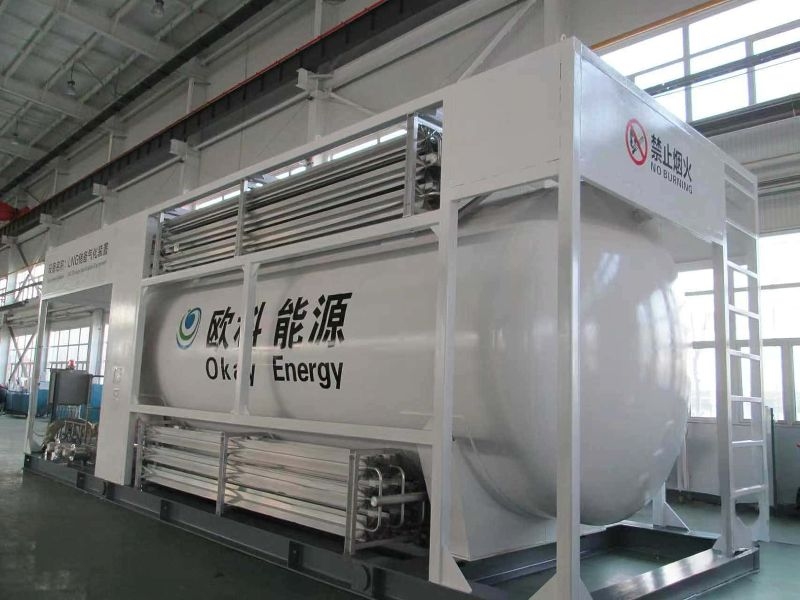
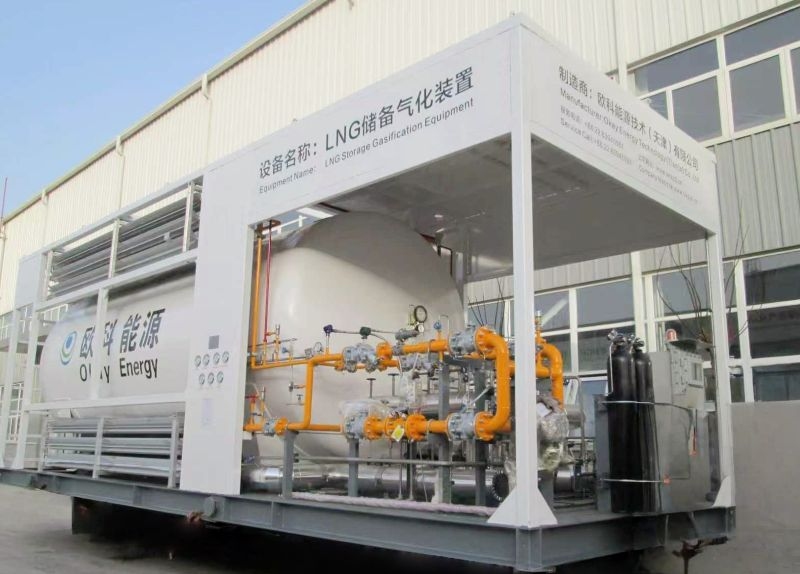
A boiler, burner, kiln, furnace, or plant gas network may have a defined inlet-pressure range. This is why we treat LNG vaporization as part of a complete gas-supply system. Okay Energy LNG Gasification Equipment can integrate vaporization, pressure regulation, metering, and control in a skid-mounted system.
Step 4: Evaluate Minimum Ambient Temperature and Frost Formation
For an ambient-air LNG vaporizer, the surrounding air is the heat source. Site minimum ambient temperature, relative humidity, wind speed, frost formation, and operating duration therefore influence available performance.
A configuration suitable for a warm climate may not provide the same continuous capacity in a colder location. The sizing review should use the project’s minimum design ambient temperature and expected operating cycle.
Step 5: Evaluate Operating Duration and Duty Cycle
An intermittent-duty plant and a continuous-duty facility may require different vaporizer configurations even when their peak gas flow rates are identical. For ambient-air systems, continuous operation can increase the importance of frost accumulation, defrost cycles, automatic changeover, and standby capacity.
Where ambient-air vaporization is unsuitable, a heated solution may be considered. Okay Energy also supplies the Electric water-bath vaporizers, which use electrically heated water and stainless-steel heat-exchange coils. Its published design includes automatic temperature control, a gas-liquid separator, and multiple safety interlocks.
Step 6: Determine Redundancy and Future Capacity
Some projects can operate with a single vaporizer, while others may require parallel units, alternating operation, or duty/standby arrangements.
Redundancy should reflect the consequence of losing gas supply, operating schedule, climate, maintenance philosophy, and realistic future expansion rather than a fixed percentage.
LNG Vaporizer Sizing Calculation
A practical LNG vaporizer capacity calculation follows four stages. First, determine maximum gas flow. Second, define LNG inlet conditions and required outlet pressure and temperature. Third, check how the selected vaporizer technology performs under minimum ambient temperature and expected operating duration. Finally, establish a project-specific design margin and redundancy strategy.
A useful screening relationship is:
The selected vaporizer should have a rated gas capacity at least equal to the required design gas flow under the specified LNG inlet, outlet, ambient, and utility conditions. The corresponding thermal duty, pressure drop, and minimum outlet temperature should also be verified.
This relationship provides an initial capacity check; final vaporizer selection requires verification of thermal duty, pressure drop, outlet temperature, and operating conditions. Avoid applying a fixed oversizing percentage without checking the actual load profile, climate, vaporizer type, and availability requirement.
LNG Tank Capacity vs. Vaporizer Capacity
LNG tank capacity and LNG vaporizer capacity describe different functions.
Tank capacity tells you how much LNG can be stored. Vaporizer capacity tells you how much LNG can be converted into gas per unit time.
Does Vaporizer Type Affect LNG Sizing?
Ambient-air vaporizers depend on climate and operating cycle. Electric water-bath vaporizers provide a controlled heat source where electrical power is available. Steam-heated vaporizers may be considered where a suitable and reliable steam supply is available and the required vaporization duty justifies the utility and heat-exchange system. Vaporizer type should be selected after establishing the process demand, thermodynamic conditions, utility availability, and site design conditions.
Thailand LNG Gas Supply Project
In our Thailand project, the skid-mounted LNG gasification station combined LNG storage, vaporization, pressure regulation, and PLC control for industrial gas supply. The 30 m³ configuration was designed for 450 Nm³/h gas supply, while the 60 m³ configuration provided 600 Nm³/h. Both used an adjustable outlet pressure of 0.1–0.3 MPa, and the project included a 200 Nm³/h unloading vaporizer.
Vaporizer sizing should therefore be coordinated with storage, unloading, pressure regulation, automation, and downstream consumption.
LNG Vaporizer Sizing Checklist
Before requesting a technical proposal, prepare:
Normal and maximum gas demand
LNG composition or supplier specification
LNG inlet pressure and temperature
Required outlet pressure and temperature
Site ambient temperature range
Operating hours per day
Available electricity, steam, or hot-water utilities
Redundancy or standby requirements
PLC, ESD, remote monitoring, and metering needs
Future expansion requirement / required future capacity
At Okay Energy, we use project-specific conditions to configure modular LNG vaporization and skid-mounted gas-supply systems. Our service scope covers engineering, equipment manufacturing, project implementation, commissioning support, and technical services.
Conclusion
Reliable LNG vaporizer sizing requires matching rated gas capacity and thermal performance to peak gas demand, LNG conditions, ambient conditions, operating duration, pressure-drop requirements, and system availability.
At Okay Energy, we supply LNG Gasification Equipment and related vaporization solutions for industrial gas supply. Our skid-mounted approach can integrate vaporization, pressure regulation, metering, and control to simplify on-site system integration.
If you are planning an LNG station or industrial fuel-gas project, contact Okay Energy with your required gas flow, outlet pressure, site temperature, and operating schedule. We can use these inputs to discuss an LNG vaporization configuration suited to your actual operating conditions.
FAQ
Q: How is LNG vaporizer capacity calculated?
A: Start with maximum gas demand, then check LNG inlet conditions, required outlet pressure and temperature, minimum ambient temperature, operating duration, vaporizer technology, and redundancy.
Q: Is LNG tank capacity the same as vaporizer capacity?
A: No. Tank capacity measures storage volume, while vaporizer capacity measures the rate at which LNG is converted into gaseous fuel. They must be coordinated but are not directly proportional.
Q: Does ambient temperature affect LNG vaporizer capacity?
A: Yes, especially for ambient-air vaporizers. Low temperatures and frosting can reduce available heat transfer, so minimum site temperature and operating cycle should be included in the design review.
Q: What information is required to size an industrial LNG vaporizer?
A: Provide normal and peak gas demand, LNG specification, inlet conditions, required outlet pressure and temperature, site climate, operating hours, available utilities, control requirements, and redundancy expectations.