
How to Prevent Liquid Carryover in LNG and LPG Vaporizers
LNG and LPG vaporization systems are designed to convert liquefied gas into gas at the required flow rate, pressure, and temperature before it enters downstream pressure regulators, metering systems, burners, boilers, furnaces, or other gas-consuming equipment. Under normal operating conditions, sufficient heat-transfer duty is provided to vaporize the liquid and achieve the specified outlet gas condition.
Problems arise when the effective vaporization capacity cannot keep up with actual demand. Partially vaporized liquid may then leave the vaporizer with the gas stream. This condition, commonly described as liquid carryover, can contribute to unstable outlet conditions and create problems for downstream gas equipment.
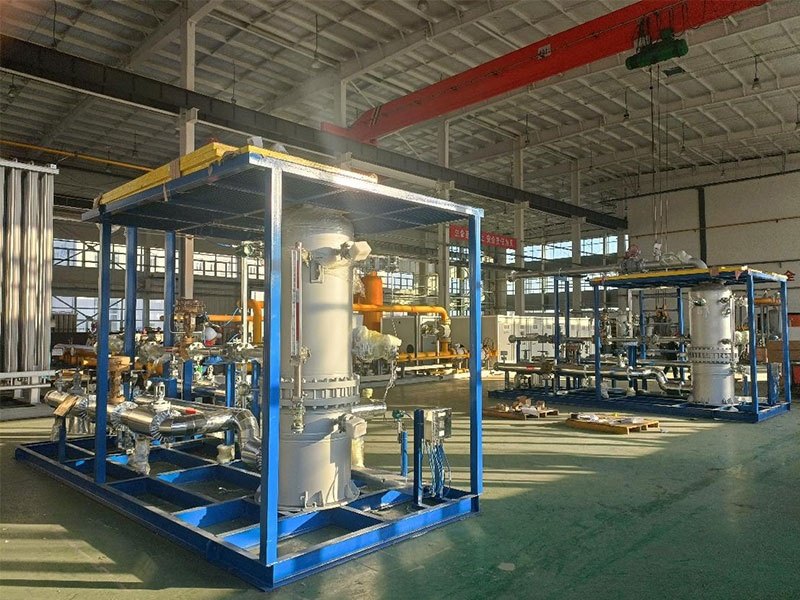
At Okay Energy, we design and manufacture LNG and LPG vaporization equipment as part of integrated industrial gas solutions. Our capabilities cover equipment design, production, installation, commissioning, personnel training, after-sales support, and related EPC engineering services.
What Is Liquid Carryover in a Vaporization System?
Liquid carryover refers to the entrainment of liquid droplets or incompletely vaporized liquid into the downstream gas stream. In LNG and LPG vaporization systems, carryover may be associated with insufficient vaporization duty, excessive flow rate, high pressure drop, unstable two-phase flow, entrainment, or downstream re-condensation.
This should not be confused with a low outlet temperature alone. A cold gas stream can still be fully vaporized. The more important issue is whether the available heat-transfer capacity and operating conditions are sufficient to complete vaporization at the design flow rate.
What Causes Liquid Carryover in LNG and LPG Vaporizers?
The Vaporizer Is Undersized for Peak Demand
One of the most common causes is insufficient vaporizer capacity for the required peak vaporization load.
A vaporizer selected only according to average consumption may perform normally most of the day but struggle when several burners start, boiler load increases, or production enters a high-demand period.
An undersized vaporizer may experience insufficient heat-transfer duty, excessive pressure drop, and unstable two-phase flow when the actual operating duty approaches or exceeds the vaporizer’s effective capacity under the prevailing operating conditions. Under these conditions, the risk of incomplete vaporization and liquid carryover increases.
For this reason, sizing should consider both continuous and peak demand rather than a single average-flow figure.
Insufficient Heat-Transfer Duty
Vaporization requires energy. The required vaporization duty depends on the liquid mass flow rate and the enthalpy increase required to achieve the specified outlet condition, while the achievable duty depends on the available heat-transfer area and overall heat-transfer performance.
Important factors include:
- liquid flow rate;
- inlet temperature;
- heating-medium temperature;
- heat-transfer area;
- required outlet gas condition;
- operating pressure.
Okay Energy’s Electric Water Bath Vaporizer uses controlled water-bath heating and includes automatic water-temperature control. Its capacity is customized according to gas type and project requirements, helping match heat-transfer performance to the actual duty.
Low Ambient Temperature Reduces Air-Vaporizer Performance
An Air Ambient Vaporizer uses heat from surrounding air. This avoids the need for electricity, steam, or hot water for the main vaporization process, but its performance is closely related to environmental conditions.
As ambient temperature decreases, the available temperature driving force for heat transfer may decrease, reducing the effective vaporization capacity of an ambient-air vaporizer. If demand remains high while available heat declines, the operating margin becomes smaller.
This is why minimum site temperature should be considered during ambient-vaporizer sizing rather than relying only on annual average weather conditions.
Frosting Restricts Heat Transfer
Frost formation is a normal operating phenomenon on ambient-air vaporizers used for cryogenic LNG service. For LPG applications, frosting behavior depends on the operating pressure, liquid temperature, composition, and ambient conditions.
Frost accumulation increases thermal resistance and can reduce the effective heat-transfer performance of an ambient-air vaporizer. In severe cases, frost can also restrict airflow through the finned heat-transfer surfaces.
For continuous-duty installations, operating philosophy may therefore include multiple vaporizers with alternating service and defrost periods instead of relying on a single ambient-air vaporizer for continuous operation under sustained heavy-frost conditions.
Why Is Liquid Carryover Dangerous for Downstream Gas Equipment?
Liquid carryover can adversely affect downstream pressure regulation, flow measurement, control-valve performance, burner stability, and fuel-gas control. Equipment designed for gaseous fuel normally depends on predictable pressure, flow, and fuel condition.
Incomplete vaporization may contribute to:
- unstable gas delivery;
- pressure and flow fluctuations;
- inconsistent burner operation;
- additional load on downstream separation or regulation equipment;
- increased inspection and maintenance requirements.
Okay Energy’s LNG technical content also notes that insufficient heat transfer can result in incomplete vaporization, liquid carryover, and unstable outlet conditions, which may affect downstream equipment requiring stable pressure and flow.
The objective is therefore not merely to eliminate visible liquid. The entire vaporization process should reliably deliver gas within the required downstream operating range.
How Can Liquid Carryover Be Prevented?
Size the Vaporizer Around Real Operating Demand
Correct sizing is the first line of prevention.
Important project parameters include:
| Parameter | Why It Matters |
| Gas type | LNG and LPG have different process conditions |
| Maximum flow | Defines peak vaporization demand |
| Continuous flow | Determines sustained operating duty |
| Inlet pressure | Influences vaporization conditions |
| Required outlet pressure | Defines downstream requirement |
| Liquid inlet temperature | Affects heat demand |
| Required gas outlet temperature | Influences heating duty |
| Minimum ambient temperature | Critical for ambient vaporizers |
| Operating hours | Helps determine duty and redundancy |
The vaporizer should be selected based on the worst-case design operating conditions rather than average consumption alone.
Match the Heat Source to the Application
Vaporizer selection should be based on the required capacity, heat source, climate, duty cycle, and outlet gas conditions.
An Air Ambient Vaporizer may be attractive where climate and operating conditions provide sufficient natural heat.
Where more controlled heating is required, Okay Energy offers the Electric Water Bath Vaporizer and Water Bath Vaporizer. The Water Bath Vaporizer transfers heat through stainless-steel tube bundles immersed in heated water and supports automatic temperature control and safety protection.
For high-capacity industrial applications where steam is available, steam-heated vaporization can also be considered. Okay Energy supplied a 25,000 kg/h steam-heated LPG vaporization system for an industrial fuel-gas pipeline project in India, integrating the vaporizer, automatic controls, safety devices, instrumentation, and skid structure.
Selection should therefore be based on gas demand, climate, heating utilities, duty cycle, and required outlet conditions.
Use a Gas-Liquid Separator as Secondary Protection
Gas-liquid separation can provide another layer of protection, but it should not be used to compensate for an undersized vaporizer.
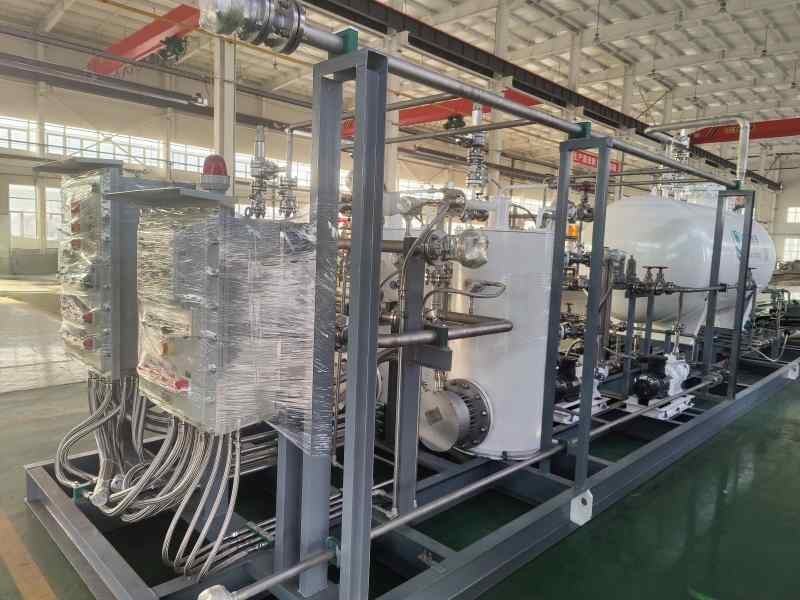
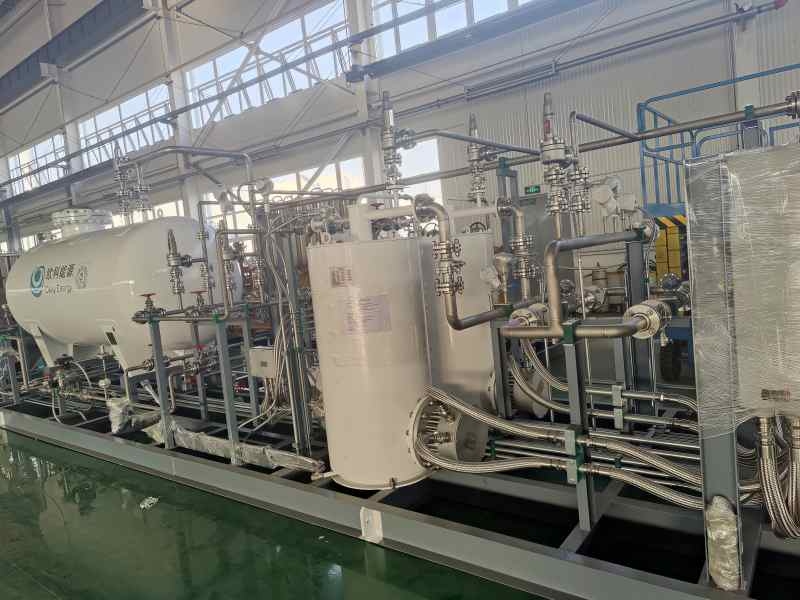
Okay Energy’s Electric Water Bath Vaporizer includes a built-in gas-liquid separator, integrated drainage, and anti-liquid-carryover protection.
The Water Bath Vaporizer likewise directs vaporized gas through a gas-liquid separator before downstream delivery.
The key distinction is:
Correct Vaporizer Sizing = Primary Prevention
Gas-Liquid Separation = Secondary Protection
If a separator repeatedly receives excessive or unexpected liquid carryover, the upstream vaporizer capacity, heat-transfer duty, operating pressure, flow rate, and control strategy should be reviewed.
Use Automatic Temperature and Safety Control
Automated control and safety interlocks can help limit liquid feed and initiate protective shutdown when operating parameters move outside specified limits.
For example, Okay Energy’s Electric Water Bath Vaporizer can incorporate automatic water-temperature control, high/low temperature alarm interlocks, low-water-level protection, automatic inlet-liquid shut-off, and overpressure protection.
These interlocks can reduce the risk of continued liquid feed when water temperature, water level, or pressure moves outside the specified operating limits.
Our broader LNG systems can also integrate vaporization, pressure regulation, metering, and control in a skid-mounted configuration.
How to Identify a Possible Carryover Problem
Operators should investigate the vaporization system when they observe several related symptoms, such as unusually low outlet temperature, excessive frosting, declining vaporizer capacity, unstable downstream pressure, or operation consistently above the original design load.
These symptoms do not automatically prove liquid carryover. They should instead trigger inspection of:
Flow demand → Vaporizer capacity → Heat-transfer duty → Frosting → Liquid separation → Control and safety interlocks
A systematic check is more useful than replacing individual components without identifying the underlying cause.
Conclusion
Preventing liquid carryover in LNG and LPG systems requires more than adding a separator. Reliable vaporization requires adequate design capacity, sufficient heat-transfer duty, appropriate operating conditions, effective liquid separation, and properly configured control and safety systems.
At Okay Energy, we evaluate gas type, flow demand, pressure, temperature, heating medium, site conditions, and control requirements when developing vaporization solutions. Our product range includes Air Ambient Vaporizer, Electric Water Bath Vaporizer, Water Bath Vaporizer, steam-heated vaporization equipment, and integrated LNG Gasification Equipment.
If your LNG or LPG system is experiencing incomplete vaporization, excessive frosting, unstable outlet conditions, or increasing peak demand, contact Okay Energy to discuss a vaporization system matched to your actual operating conditions.
FAQ
Q: What causes liquid carryover in an LNG or LPG vaporizer?
A: Common causes include insufficient vaporizer capacity, inadequate heat input, low ambient temperature, excessive frosting, and sudden increases in gas demand. When the effective vaporization capability becomes lower than the required duty, some liquid may not fully vaporize before reaching the outlet.
Q: Can an undersized vaporizer cause liquid carryover?
A: Yes. If actual LNG or LPG flow exceeds the effective vaporization capacity, the liquid may not receive enough heat to complete vaporization. Correct sizing should therefore consider peak flow, continuous demand, site temperature, and required outlet conditions rather than average consumption alone.
Q: Can a gas-liquid separator completely solve liquid carryover?
A: No. A gas-liquid separator provides useful secondary protection by removing entrained liquid, but it cannot replace adequate vaporization capacity. Repeated carryover should prompt a review of vaporizer sizing, heat input, actual flow, frosting, and operating conditions.
Q: Is a water bath vaporizer better for cold-weather applications?
A: A water bath system provides a controlled heat source and is less dependent on ambient-air temperature, which can make it suitable for cold climates or demanding continuous-duty applications. However, vaporizer selection should still be based on gas demand, available utilities, operating conditions, and project requirements.