
Industrial gas blending systems often operate under variable gas supply and process conditions. Gas composition, flow rate, supply pressure, and downstream demand may change during normal plant operation. When these variables change, the calorific value of the final fuel mixture can also fluctuate.
For boilers, furnaces, kilns, steel heating processes, and other combustion equipment, an unstable fuel quality can make heat input and process control less predictable. The solution is not simply to maintain one fixed mixing ratio. A reliable industrial gas blending system must continuously measure operating conditions and adjust individual gas flow rates to maintain the specified outlet gas quality and operating conditions.
Okay Energy designs and manufactures industrial gas blending systems, calorific value control systems, and skid-mounted gas processing equipment for applications including natural gas blending, LPG vaporization, SNG production, CNG pressure reduction, and natural gas pressure regulation and metering.
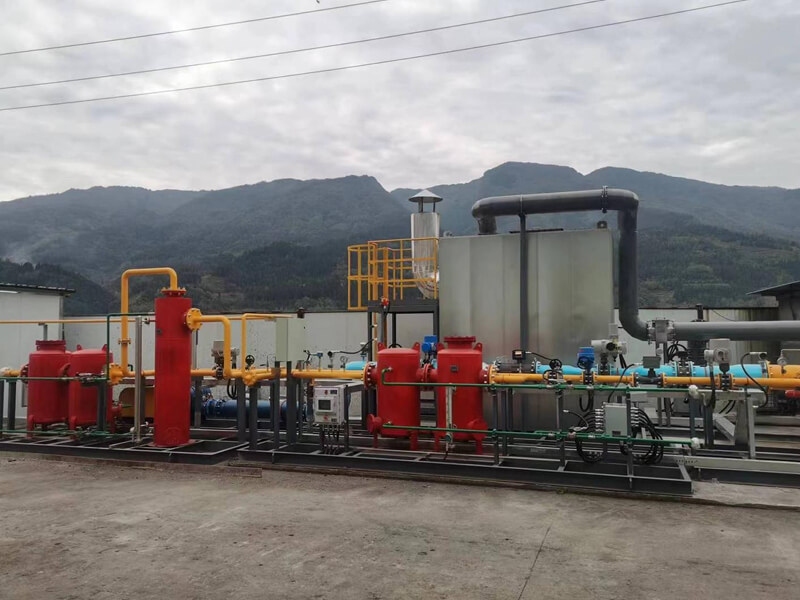
What Causes Calorific Value Fluctuations in Industrial Gas Blending Systems?
Changes in Gas Composition
Different gaseous fuels have different heating values because their chemical compositions and concentrations of combustible components differ. Their Wobbe Index can also vary significantly, which is important when evaluating fuel-gas interchangeability and burner performance. Natural gas, LPG, hydrogen, coke oven gas, blast furnace gas, and other industrial gases should not be considered interchangeable based solely on volumetric flow rate. Fuel interchangeability depends on parameters such as gas composition, heating value, Wobbe Index, supply pressure, and burner requirements.
The challenge becomes greater when industrial by-product gases are involved. Their composition may vary as upstream production conditions change. Even if the flow ratio remains unchanged, the resulting mixed-gas calorific value may shift.
Okay Energy’s Heat Value Control System is designed for combinations including natural gas, LPG, hydrogen, ammonia, nitrogen, air, and industrial associated gases such as blast furnace gas and coke oven gas. The system can adjust gas proportions according to the required application.
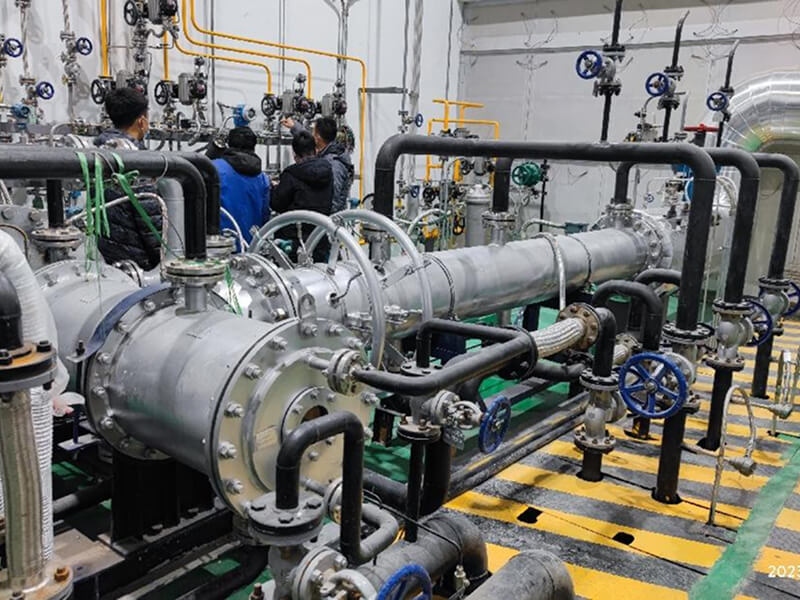
Changes in Flow and Blending Ratio
A nominal blending ratio does not necessarily guarantee that the actual gas flows remain at that ratio.
Changes in inlet pressure, control-valve characteristics, upstream supply conditions, or downstream demand can affect individual gas flow rates and the total blended-gas flow. Without appropriate flow measurement and control, the actual blending ratio may deviate from the target. For example, maintaining the same control-valve position does not automatically mean Gas A and Gas B will continue flowing at exactly the same proportion.
Accurate calorific value control therefore depends on measurement and active flow adjustment rather than fixed valve settings.
Changing Industrial Loads
Fuel demand also changes during normal plant operation. Furnaces may change production rates, boilers may respond to varying steam demand, and several burners may start or stop at different times.
The control system must accommodate both variations in fuel-gas quality and changes in downstream fuel demand. Gas-quality variations may require adjustment of the blending ratio, while changes in downstream demand require corresponding adjustment of the total fuel-gas flow rate. Okay Energy’s control platform uses real-time feedback and dynamic blending-ratio adjustment to respond to gas-source fluctuations and changing loads.
What Happens When Calorific Value Becomes Unstable?
Calorific value represents the amount of energy available from a given quantity of fuel. For a volumetric flow-based fuel supply, variations in higher heating value (HHV) or lower heating value (LHV) can cause corresponding changes in the energy input rate unless the fuel flow is compensated.
For industrial furnaces, boilers, kilns, and heating equipment, this can make combustion and process-temperature control more difficult. Operators may need to compensate more frequently, while processes that depend on repeatable thermal conditions can become less consistent.
This is particularly relevant to industries such as steel, glass, ceramics, chemicals, and power generation, where fuel-gas quality is closely connected with stable thermal operation.
Maintaining a more predictable fuel-gas quality can improve the consistency of fuel-energy accounting and process control. When gas quality is predictable, operators can relate fuel flow more consistently to the energy being delivered to the process.
Why Is a Fixed Gas Blending Ratio Not Always Enough?
A fixed ratio can work when the properties of both gases remain stable. However, many industrial applications do not operate under such ideal conditions.
Suppose a system is configured to blend two gases at a fixed proportion. If the calorific value of one industrial by-product gas changes, maintaining the same percentage of each gas will not necessarily maintain the same final calorific value.
This creates an important distinction:
- Fixed Ratio Control: Maintain a predetermined percentage of each gas.
- Calorific Value Control: Adjust the gas ratio when necessary to maintain the required output fuel quality.
For applications with variable fuel sources, the second approach provides greater flexibility. The control objective becomes the required output condition rather than simply keeping two flow percentages unchanged.
How Does an Automatic Calorific Value Control System Work?
Measure Gas Flow and Operating Conditions
The first stage of the control process is to measure the operating parameters of each incoming gas stream. Flowmeters and instrumentation provide operating data for the individual gas streams, while pressure regulation helps maintain suitable inlet conditions.
Okay Energy’s wider equipment portfolio includes gas turbine flowmeters, ultrasonic flowmeters, mass flowmeters, pressure transmitters, temperature transmitters, regulators, and shut-off valves that can support integrated gas-processing systems.
Compare Actual Output with the Target
The control system compares measured operating parameters with predefined setpoints for flow, pressure, gas quality, or other process requirements.
The basic control logic can be summarized as:
Measure → Compare → Calculate → Adjust → Feedback
Rather than making one adjustment and leaving the system unchanged, closed-loop control repeatedly checks the operating condition and responds to changes.
Automatically Adjust the Gas Ratio
If the calculated or measured outlet gas quality deviates from the target condition, the control system adjusts the flow contribution of the relevant gas streams.
Okay Energy’s Heat Value Control System uses an independently developed dynamic blending algorithm and sensing system. The published product specifications state a heat-value control accuracy of ±1%, with accuracy improved to ±0.5% in key application scenarios.
The system also supports automatic control and switching between multiple gas sources, real-time feedback, and dynamic adjustment of the blending ratio.
Key Components of a Calorific Value Control System
A complete system requires more than a mixing chamber.
| Component | Engineering Function |
| Gas Flow Meter | Measures individual gas flow rates |
| Pressure Regulator | Stabilizes inlet/outlet gas pressure |
| Control Valve | Modulates individual gas flow |
| Pressure Transmitter | Provides real-time pressure feedback |
| Temperature Transmitter | Provides temperature compensation |
| Gas Analyzer / Composition Analyzer | Monitors gas composition where required |
| Static Mixer / Mixing Chamber | Promotes uniform gas mixing |
| PLC Control System | Executes ratio control and interlocks |
| ESD Valve | Provides automatic emergency isolation |
| Gas Detection System | Detects combustible gas leakage |
| Safety Relief Device | Protects the system from overpressure |
Okay Energy integrates these functions into modular skid-mounted systems. The Heat Value Control System also incorporates combustible-gas detection, pressure monitoring, flow-deviation alarms, and automatic emergency shutdown (ESD) as part of the system’s integrated safety and protection functions.
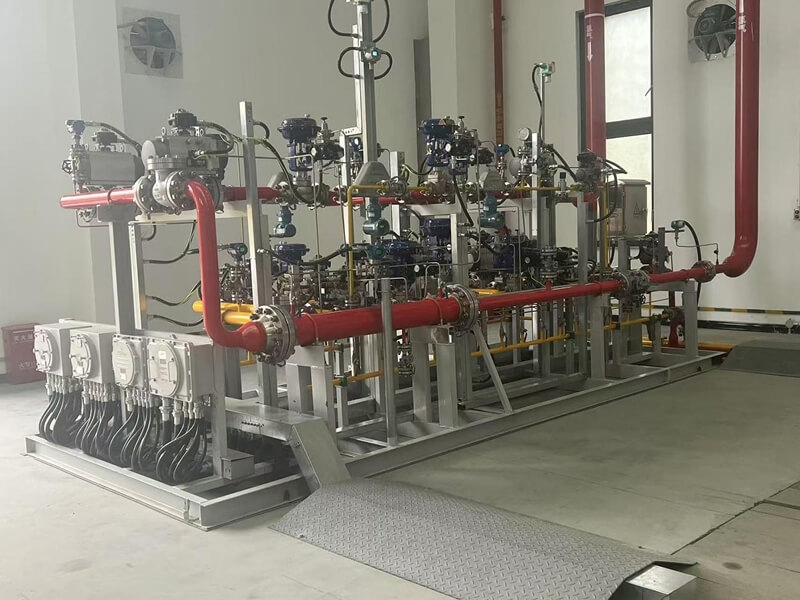
Where Is Calorific Value Control Useful?
Steel Production
Steel plants can generate several fuel gases, including coke oven gas and blast furnace gas. Rather than treating these streams only as low-calorific-value process gases, a blending system can combine them with higher-calorific-value fuel according to the plant’s required gas quality.
Okay Energy has applied its blending technology to steel-industry projects involving coke oven gas, blast furnace gas, and natural gas.
Glass, Ceramics, Boilers, and Industrial Furnaces
Continuous thermal processes benefit from predictable fuel conditions. When the gas source varies, calorific value control can help keep the supplied mixed gas closer to the required operating target.
The exact control requirement should always be determined by the burner, furnace, boiler, or downstream process rather than applying one universal blending ratio.
SNG Production
Synthetic natural gas is another practical example.
In a Southeast Asia project, Okay Energy supplied a 6000 Nm³/h SNG Blending System using LPG and air. The system operates at a published working pressure of 0.2 MPa and uses dynamic flow-proportional mixing. It integrates LPG vaporization, air supply, proportional blending, pressure regulation, PLC control, flow measurement, and safety protection.
The project demonstrates why automatic ratio control matters: the objective is not simply to mix LPG and air, but to produce an LPG-air gas mixture with controlled gas quality suitable for the specified downstream application.
How to Select a Calorific Value Control System
A buyer should not select a blending system only by nominal capacity.
Important project information includes:
- gas types and compositions;
- inlet pressures and temperatures;
- minimum and maximum flow rates;
- required calorific value;
- expected variation of each gas source;
- downstream equipment and process requirements;
- available installation space and utilities;
- automation and communication requirements;
- safety and redundancy requirements.
These inputs determine the required metering, pressure regulation, valve sizing, control logic, blending arrangement, and skid configuration.
At Okay Energy, we provide modular skid-mounted equipment and turnkey engineering support for calorific value control and other gas-processing applications. Our service scope includes solution development, equipment manufacturing, installation, commissioning, and technical support.
Conclusion
Controlling calorific value fluctuations requires more than maintaining a fixed gas ratio. Changes in gas composition, flow, inlet conditions, and downstream load can all affect the final fuel quality.
An effective control strategy combines accurate flow measurement, pressure regulation, automatic ratio adjustment, real-time feedback, PLC control, and appropriate safety protection.
Our Heat Value Control System is designed to manage multiple gas sources through dynamic blending while adapting to changes in supply and demand. For projects involving natural gas, LPG, industrial by-product gas, SNG, hydrogen, or other mixed-fuel applications, contact Okay Energy to discuss a customized calorific value control solution based on your gas composition, flow range, pressure conditions, and required output quality.
FAQ
Q: What causes calorific value fluctuations in an industrial gas blending system?
A: Common causes include changes in gas composition, individual stream flow rates, supply pressure, temperature, and downstream demand. Industrial by-product gases such as BFG, COG, and converter gas may exhibit significant composition and heating-value variations as upstream production conditions change.
Q: Can a fixed gas blending ratio maintain a stable calorific value?
A: It can work when the composition and operating conditions of each gas source remain stable. If one gas changes in composition or energy content, however, the blending ratio may need to be adjusted. Closed-loop calorific value control is more suitable for variable gas sources.
Q: How does an automatic calorific value control system work?
A: The system measures gas flow and operating data, compares the actual condition with the target, and uses a PLC or control platform to adjust individual gas flows. The process repeats continuously so the system can respond to gas-source or load changes.
Q: What information should I provide to a gas blending system manufacturer?
A: Gas types and compositions, flow range, inlet and outlet pressures, temperatures, target calorific value and Wobbe Index, downstream equipment, load profile, control requirements, safety requirements, and site conditions.