
An LNG storage tank is dimensioned based on buffer hours and not on the vaporizer capacity next to it. The relevant parameters for the volume of a cryogenic gas supply system are: volume, insulation, inner-shell material and filling degree. This guide explains what has to be fixed before a tank can be specified and where a tank specification goes wrong.
What an LNG Storage Tank Does in a Gas Supply System
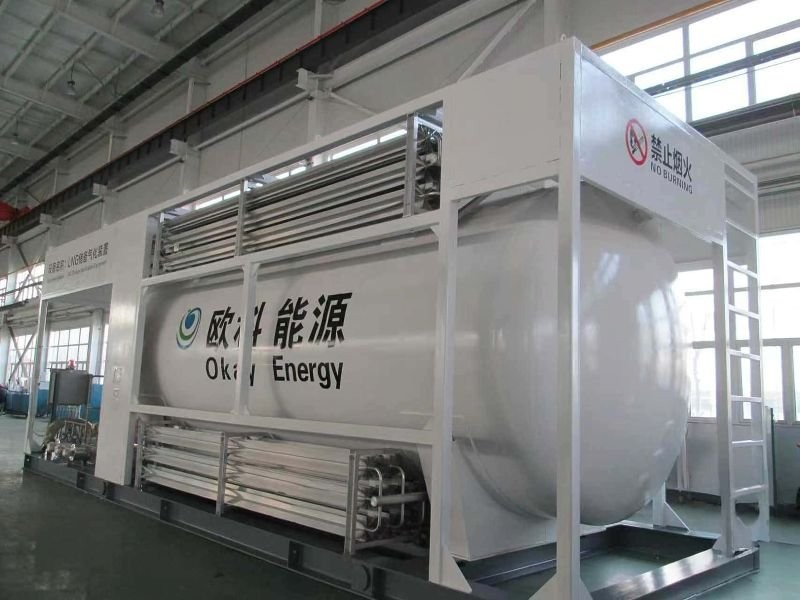
This tank holds Liquefied Natural Gas at cryogenic temperatures to ensure a supply of gas at your site should the pipeline, delivery date and downstream requirements not meet. This is the inventory portion of the overall system – how long you can keep running, and how much gas you can deliver in an hour, is defined by the tank, and the vaporizer. The complete skid-mounted station contains this tank, plus vaporizer, pressure reduction, measurement and PLC control.
Sizing the Tank to Buffer Hours, Not Vaporizer Flow
First establish how long a site can run between deliveries. Then express the site’s gas usage over this period of time. A vaporizer’s working capacity and the quantity of gas that a tank can hold are two quite different parameters and a tank selected solely on the basis of vaporizer capacity can easily run dry during a prolonged shut down.
Two Working Volume Ranges (10–60 m³ and 50–200 m³)
Our cryogenic LNG tanks are manufactured in two different working ranges. The 10–60 m³ range is for integrated storage and vaporization units and for so-called satellite stations, supplying industry and households without a connection to a pipeline. The 50–200 m³ range is for peak demand and for cover of a broken pipeline. This can be a steel mill buffer storage or a municipal emergency regulating station. A 30 m³ system was delivered at 450 Nm³/h, a 60 m³ system at 500–600 Nm³/h and a 200 m³ system at 8,000 Nm³/h.
Why Usable Volume Sits Below Nameplate
A cryogenic tank is not filled up to the top. For this type of design, normal filling is typically carried out at around 90% filling level in order to allow for the expansion of the liquid as well as for a gaseous space above it. The actually usable volume of a tank as calculated for a project therefore is always below the nameplate capacity of the tank. For the buffer-hour calculation the usable volume has to be indicated instead of the nominal size of the tank.
Insulation and Boil-Off in a Double-Wall Vacuum Tank
In simple terms the insulation of an LNG tank keeps the LNG in a liquid state. Heat transfer through the outer tank wall causes the LNG to vaporize as boil-off gas. The use of this boil-off gas as fuel or its release to atmosphere is a major operating cost and hence a low heat transfer rate through the tank wall is of economic significance as well as being a design parameter.
Perlite Fill versus High-Vacuum Multi-Layer
Okay Energy supplies double-wall vacuum tanks, which are insulated in two ways: by filling the annular space between the two shells with perlite powder or by multi-layer high-vacuum wrapping. The choice between these two forms of insulation is mainly determined by the size of the tank, the required holding time and the way in which the boil-off gas is dealt with on site.
Reading a 2.3‰ per day Evaporation Rate
The Evaporation Rate for these tanks is specified at 2.3‰ per day or below. This figure describes the amount of tank contents that boil off in a day at design conditions. Hence it directly affects Holding Time and a lower figure allows for a longer period between deliveries for the same volume of product. If the boil-off gas cannot be used then this loss becomes an operating cost and should be compared between quotations.
Inner Shell Material and Cold-Service Design
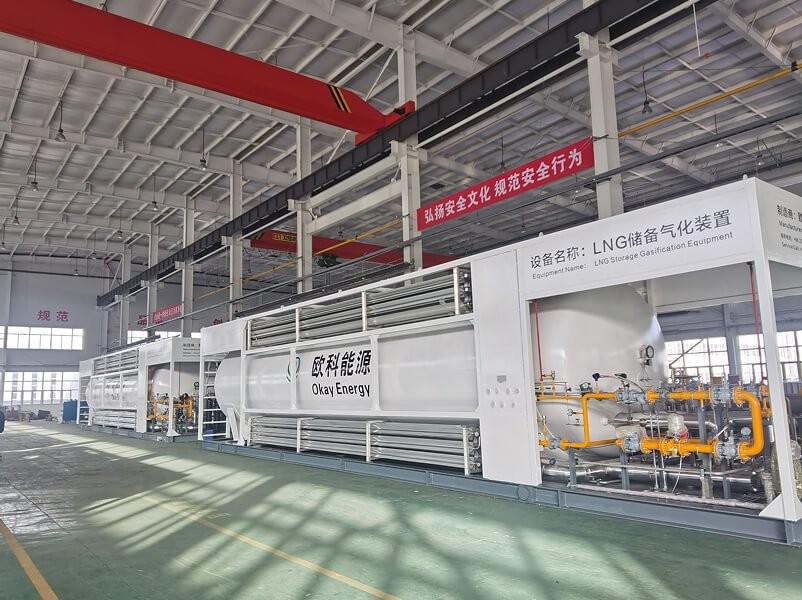
The inner shell is manufactured from 06Cr19Ni10 stainless steel, a material which retains its toughness at the low temperatures encountered in LNG service. A storage tank is a type of pressure vessel designed as a cold container and as such, the design must meet both low temperature and site pressure conditions. The group has held pressure piping component manufacturing and installation licenses since 2011 and were one of the first companies within the industry to achieve these licenses for component manufacturing and installation.
Project References from 0.84 m³ to 200 m³
Okay Energy’s storage tanks vary in size from a 0.84 m³ cylinder group for residential gas supply to a 200 m³ system operating at 8,000 Nm³/h for peak shaving. For PetroChina a 60 m³ system at 500 Nm³/h was supplied. CNOOC was provided with a 30 m³ satellite unit operating at 200 Nm³/h as a cooking-gas system. The 150 m³ system at 8,000 Nm³/h was supplied to Jianlong Group as pipeline-outage reserve for a steel mill.
Why Okay Energy Builds the Tank and Vaporizer as One Skid
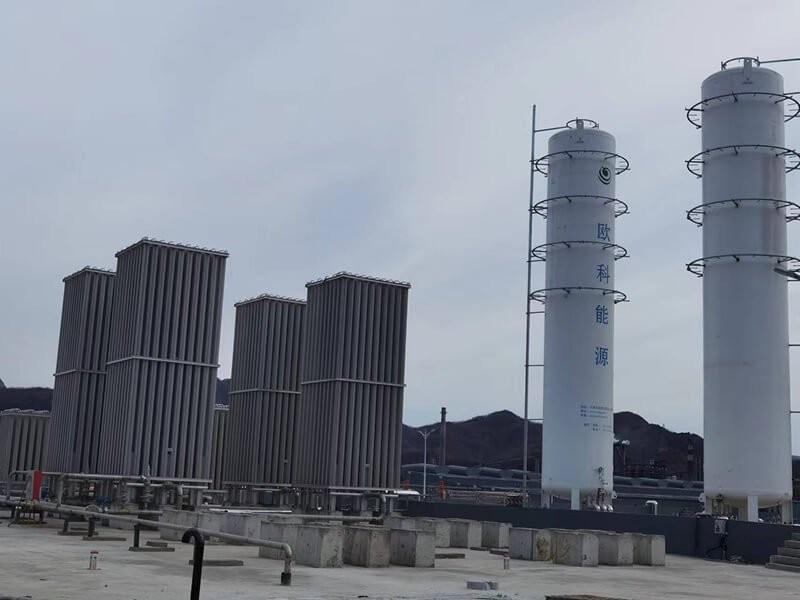
As a specialized manufacturer of cryogenic gas equipment since 2010, Okay Energy can supply complete cryogenic gas plants including the vessel, ambient air vaporizer, pressure regulating and metering skid and PLC control system as a complete and factory tested package. For one integrated configuration, the complete gas plant is approximately 17 m x 3 m x 3 m in dimension and is road transportable with DN50 quick connect flanges and lifting lugs built into the vessel frame. Factory integration can reduce site work to foundations, connections and other site-specific requirements. Storage, vaporization and control of the gas are all sized as an integrated complete package to provide a consistent set of parameters including buffer hours, peak flow and outlet pressure which are matched as part of the design and not as an afterthought on site.
Okay Energy is a national high-tech company with ISO9001/14001 and OHSAS18001 certificates and over 60 patents. Around 20% of Okay Energy’s business is conducted in markets outside of China, including Jordan, Thailand and Ghana. The same engineering team manages all of Okay Energy’s domestic and export projects.
Conclusion
A reliable supply of cryogenic gases starts with a tank of sufficient size to cover the desired buffer time, peak consumption, and boil-off, in addition to the fill degree. This is more important than comparing quotes, and four values need to be set correctly for the tank and the remaining part of the skid. For a new gas supply station, please provide the buffer time in hours, peak consumption in m³/h, ambient temperature in °C, and outlet pressure in MPa, and we can then configure the tank and the rest of the skid accordingly.
Q: How large an LNG storage tank do I need?
A: Use the buffer hours that a station needs to cover multiplied by the real gas demand and not the vaporizer capacity to dimension the tank. For an integrated station or a satellite station a tank dimension of 10–60 m³ is a typical range. For a station which needs to cover peak demand or a pipeline failure a tank dimension of 50–200 m³ is a typical range.
Q: What is a normal evaporation rate for an LNG storage tank?
A: It is held at 2.3‰ per day or below at the design condition. In other words, a lower evaporation rate means a longer holding time for the same volume. If such boil-off gas cannot be used, it will form part of the operating cost.
Q: Can a cryogenic storage tank be delivered as part of a road-transportable skid?
A: Yes. For an integrated configuration, components like storage, vaporization, pressure control, measurement and PLC control can be assembled and tested as one unit, roughly 17 m long, 3 m wide and 3 m high. This container unit has DN50 quick-connect flanges and lifting lugs. Factory integration can reduce site work to building a base, connections and other site-specific requirements.
Q: Why is the filling level limited to about 90%?
A: LNG expands as it warms up. Thus the storage tank is not filled up to the top. For this type of design, the maximal filling degree is typically controlled at about 90% to keep a gas space above the liquid. The buffer hours are to be planned on the basis of the usable volume of the tank as opposed to the nominal capacity.