
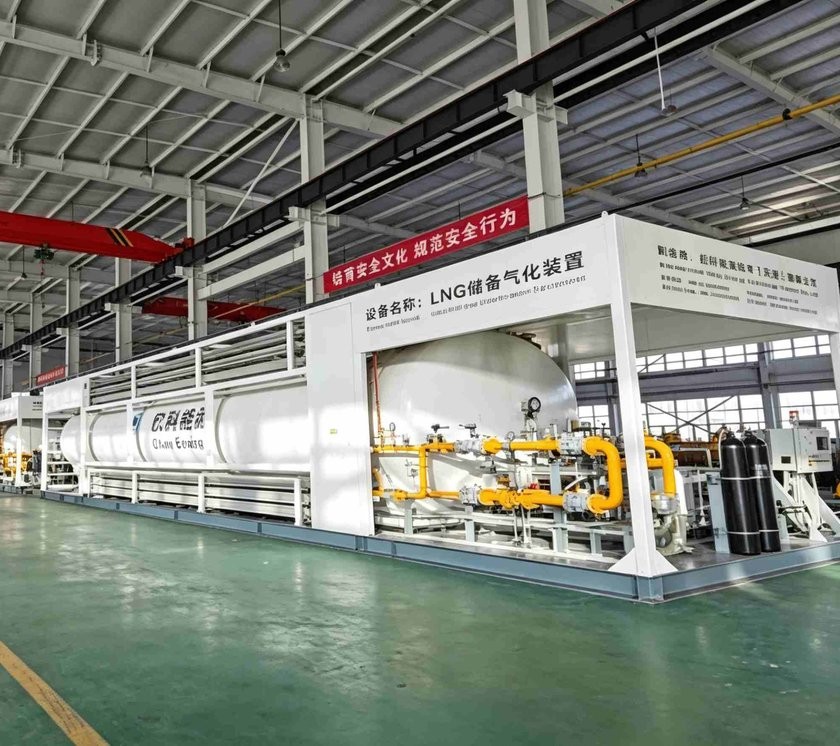
An LNG peak shaving station is a local storage of Liquefied Natural Gas which is vaporized and supplied to the grid when the pipeline supply is not sufficient. It can bridge pipeline breakdowns, heating peak demand in winter and supply remote locations without any pipeline connection. Our LNG peak shaving stations are delivered as a complete unit, so-called skid, which can be transported on the road and contains all necessary equipment for storage, vaporization, pressure regulation, measurement and control.
What an LNG Peak Shaving Station Does
The station receives LNG by truck and holds it in a cryogenic tank. When demand rises or pipeline pressure drops, LNG is fed to ambient-air vaporizers, warmed back into gas, regulated to the required outlet pressure, and metered before it enters the user’s network. The tank and vaporizer perform two different jobs: the tank sets how long you can run, and the vaporizer sets how much gas you can deliver per hour. Because the skid is built and pressure-tested in the factory, on-site installation work can be reduced, which shortens the time from delivery to first gas.
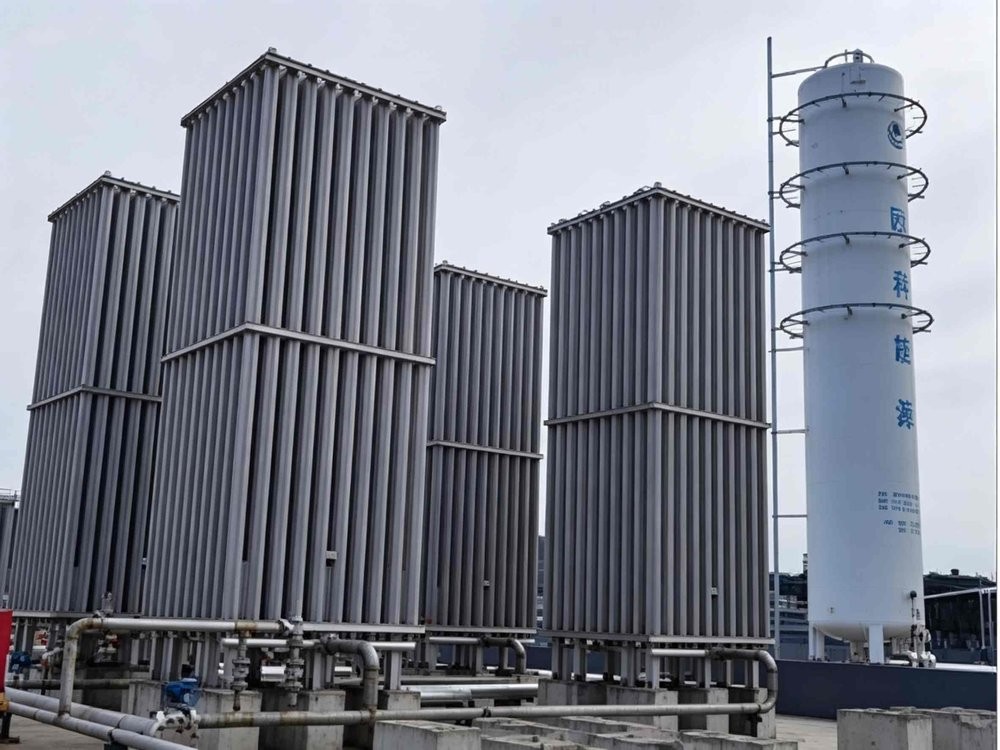
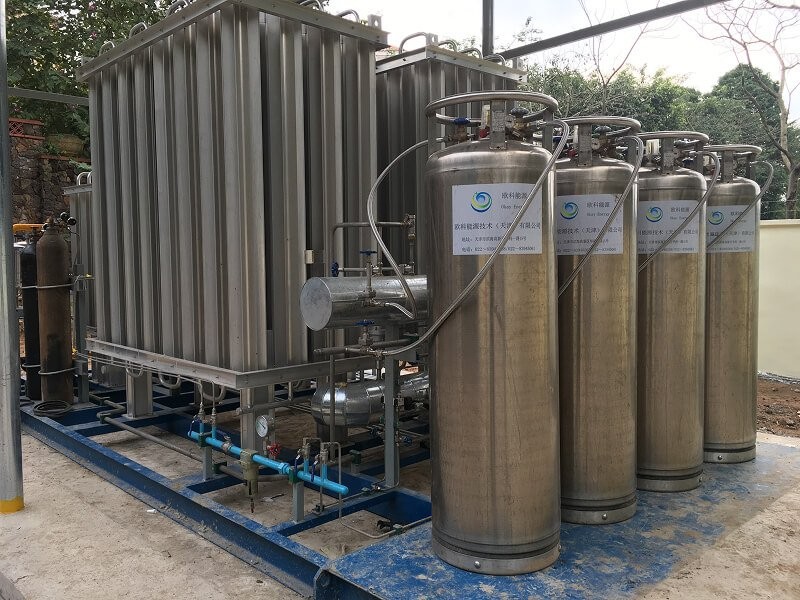
For a peak shaving plant, a typical storage capacity of a tank is in the order of 50 m³ to 200 m³ and the evaporation capacity is around 500 Nm³/h to 10,000 Nm³/h. Typical system design pressure can be around 0.8 MPa and the outlet can be adjusted to a lower pressure around 0.4 MPa. The storage tank is of double-wall vacuum type and is made of 06Cr19Ni10 for the inner shell. The evaporation rate is controlled to be on or below 2.3‰ per day. For the ambient-air type vaporizer, a stainless-steel finned-tube bundle is used with 6063 aluminum fins and designed for an inlet temperature of -196°C.
When Cities and Plants Actually Need Peak Shaving
Pipeline Outage and Emergency Backup
An unplanned pipeline rupture, scheduled pipeline maintenance, or supply interruption to a city gas distribution network or an industrial gas user can take hours to be restored. In the meantime a peak shaving station can start to release from inventory within the buffer and start to vaporize to feed boilers, industrial furnaces and residential networks. Jianlong Steel’s 150 m³ unit operates at 8,000 Nm³/h as a pipeline outage backup. This allows a furnace to continue to operate without interruption for hours.
Municipal Peak Demand and Seasonal Gaps
Winter peak demand for space heating often exceeds the pipeline capacity for extended periods of time. Municipalities seek to avoid large capital expenditures for additional transmission capacity by implementing peak shaving programs. The same skid can be used as a municipal gas emergency regulation station.
How the Skid Integrates Storage and Vaporization
Storage Tank Sizing (50–200 m³)
When choosing a tank size, you should choose based on the number of hours you want your buffer to last for, not the rate of vaporization. A 50 m³ tank is suitable as a short term industrial buffer, whilst a 200 m³ tank can provide a longer buffer depending on the actual gas demand. For this type of design, the maximum filling level is typically controlled at around 90%, therefore the usable volume of the tank is slightly less than the nameplate.
Vaporization Capacity (500–10,000 Nm³/h)
The vaporization rate is one of the important factors to reach the peak flow of a gas buffer. A capacity of 500 Nm³/h can be suitable for some industrial applications, whereas capacities up to 10,000 Nm³/h can be required for larger peak demand applications. Because of a loss of performance in cold and frosting ambient conditions, the capacity of an ambient-air vaporizer has to be checked for cold sites against the minimum ambient temperature. Additional electric or steam heated vaporizers can be mounted on the same skid. For continuous operation of such a gas buffer, a standby unit or even a heated up backup unit can be required.
Real Project References
Steel Mill Pipeline-Outage Backup
A steel plant cannot afford to shut down a furnace for an extended period. This is where a 150 m³ peak shaving skid, operating at up to 8,000 Nm³/h, can provide a mill with hours of buffer storage in the event of a pipeline interruption. Our Zhengmao Gas model operates with a 200 m³ unit at up to 8,000 Nm³/h for peak/stand-by duty.
Remote Sites
Peak shaving and LNG gasification units can also be used to supply remote mining and construction sites that have no pipeline supply. The temporary power or heating requirements of these sites are converted into a constant gas supply.
Sizing an LNG Peak Shaving Plant
Storage Volume vs Vaporization Rate
Storage of a process fluid and its vaporization are two separate functions. A large storage tank with a small vaporizer may not be able to provide peak flow. On the other hand, a large vaporizer with a small storage tank will not be able to run for a long time and therefore additional standby capacity is required for the required availability of a process.
Pressure, Climate, and Control
From inlet and outlet pressures, minimum site ambient temperature, runtime hours, available utilities. A PLC controlled, Modbus linked skid allowing full remote monitoring and metering to ±0.5% accuracy, enables unattended operation down to -18°C. Delivery pressure to users’ network can then be set as required.
Why Okay Energy Builds Peak Shaving Skids as Turnkey Units
Okay Energy is a national high-tech enterprise, established in 2010, which specializes in design, manufacturing and supply of complete set of LNG storage and vaporization equipment, including storage tank, vaporizer, regulator, flow meter and PLC control systems in integrated skid-mounted or modular packages which can be tested in the factory before being delivered. As early as 2011, the company has got the licenses of pressure piping components and installation, and the company holds ISO9001/14001 and OHSAS18001 certificates, and over 60 patents. After 15 years’ development in gas equipment industry, Okay Energy has supplied LNG equipment and other gas equipment to many renowned oil and gas operators at home and abroad, such as Sinopec, CNOOC, PipeChina, China Energy and ExxonMobil. The company’s export projects are widely distributed across the Middle East, Southeast Asia and Africa, including Jordan, Thailand and Ghana. All of the skid-mounted LNG storage and vaporization solutions from the company are designed according to specific project conditions and are not limited to a few fixed types.
Conclusion
Reliable peak shaving requires a stored volume of LNG and a corresponding vaporization capacity that corresponds with the peak and the associated outage risk. A properly dimensioned LNG peak shaving station thus turns a pipeline failure into a manageable buffer instead of a complete shutdown. We will be glad to make you a binding offer for a peak shaving station or an emergency backup station after you have specified the required buffer hours, the peak to be covered, the site temperature and the outlet pressure.
Q: What is the difference between an LNG peak shaving plant and an LNG satellite station?
A: A satellite station is an off-grid supply in a smaller size, typically 10–60 m³ and 50–500 Nm³/h for no-pipeline customers. A peak shaving plant is bigger and is installed next to a pipeline to cover peaks as well as to prevent supply interruptions. Both types can be equipped with the same skid design.
Q: How large a storage tank do I need for peak shaving?
A: The dimensioning of the storage tank is based on the number of hours that you like to buffer against. A 50 m³ tank is for a short industrial buffer storage. A 200 m³ tank can provide a longer buffer, depending on the actual gas demand. For this type of design, the maximum filling level is typically around 90%. Dimensioning of the vaporizer for peak load separately.
Q: Can an LNG peak shaving station run unattended?
A: Yes. Our panel mounted equipment is often supplied with PLC control and Modbus remote monitoring on -18°C sites. Metering accuracy is held to ±0.5% and pressure is automatically regulated to ensure safe unattended operation of plant. Local site inspection of plant will still be in accordance with the relevant safety plan.
Q: What are the typical system design and delivery pressures?
A: Typically we would design the system for around 0.8 MPa, with the downstream outlet pressure around 0.4 MPa, but these can be adjusted to meet the project requirements. The integrated skid includes control and metering of the downstream gas to deliver at the required pressure within the users network.