
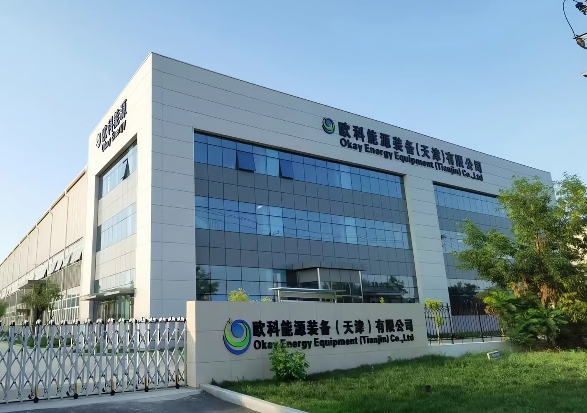
A natural gas-hydrogen blending system improves industrial energy flexibility by combining hydrogen with natural gas at a controlled ratio, pressure, and flow rate. For facilities exploring lower-carbon fuel pathways without necessarily requiring complete replacement of existing gas infrastructure, the system provides a practical solution for maintaining stable fuel quality and adapting existing energy networks. According to Okay Energy project experience, natural gas-hydrogen blending systems are designed to achieve precise hydrogen mixing, stable gas composition, and reliable operating performance across different industrial applications. This flexibility is important because hydrogen influences the calorific value, Wobbe Index, and combustion characteristics of the blended gas stream. A properly engineered system maintains the target blending range through accurate metering, pressure regulation, and automated ratio control rather than relying on manual adjustment.
Why Industrial Users Need Precise Hydrogen Blending
Managing Calorific Value and Combustion Behavior
Hydrogen blending involves more than introducing an additional fuel component. It is also about keeping the mixed fuel predictable for burners, turbines, and test systems that are designed around specific operating conditions. If the ratio drifts, the resulting gas can move away from the intended calorific value and change how the downstream process performs. In addition to calorific value, Wobbe Index and combustion characteristics are important parameters for evaluating hydrogen blending compatibility with downstream equipment.
Controlling Pressure and Inlet Conditions
In practical projects, the inlet pressure of hydrogen can be much higher than the natural gas line pressure, so the blending train must coordinate both streams through pressure regulation and flow balancing to maintain stable blending conditions.
How a Natural Gas-Hydrogen Blending System Works
Flow Measurement and Ratio Control
The process starts with accurate metering of both gas streams. The product architecture described in project materials combines filtration, a mixing chamber, pressure regulation equipment, flow meters, pressure transmitters, an instrumentation system, and a PLC control system, so the system can react to changing inlet conditions and preserve the target blend.
Mixing Chamber and Uniformity
Once the streams are measured and adjusted, they pass through the mixing section to reach a uniform composition. The difference between a theoretical blending concept and a validated industrial application lies in achieving stable outlet gas quality under real operating conditions. Depending on the design requirements, the mixing section may use static mixing or proportional blending technology to achieve consistent gas composition.
Monitoring and Automation
Automation provides operators with real-time visibility into system operating conditions. With PLC-based control, the blend can be monitored in real time, while pressure transmitters and flow meters monitor operating conditions.
Verified Project Parameters from Okay Energy
Gas Turbine Test Platform
One verified application involves a gas turbine test platform for Zhejiang Energy Group Co., Ltd., with high-pressure hydrogen and natural gas blending requirements. The documented parameters include a natural gas flow rate of 3000 Nm3/h, natural gas pressure of 4.3 MPa, hydrogen flow rate of 7800 Nm3/h, hydrogen pressure of 20 MPa, blending gas flow rate of 10000 Nm3/h, hydrogen volume fraction adjustable from 10% to 90%.
Tsinghua University Test Platform
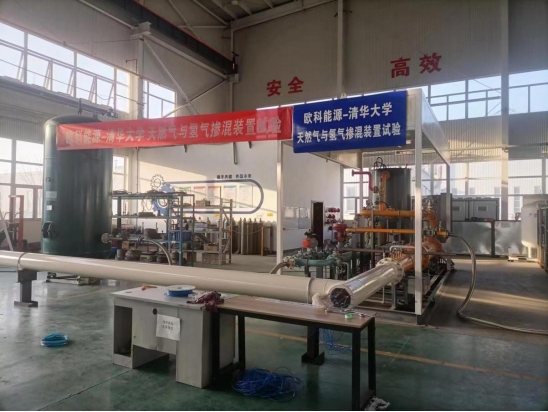
A second verified platform for Tsinghua University shows hydrogen volume fraction adjustable from 5% to 50%, hydrogen inlet velocity of 5-10 m/s, blending uniformity of 99%, and accuracy of ±1%. This demonstrates that the system can support different operating windows.
Broader Calorific Value Control Range
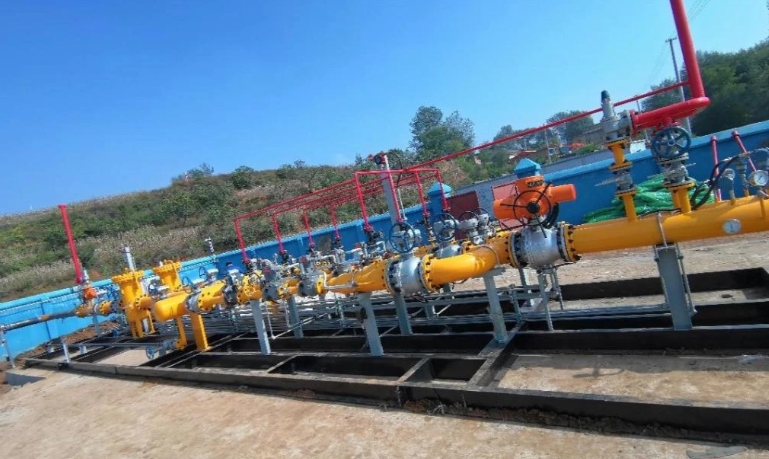
Okay Energy also documents a broader calorific value control system for natural gas, LPG, air, nitrogen, coalbed methane, blast furnace gas, coke oven gas, converter gas, and producer gas.
Where the System Fits in Real Projects
Power and Test Environments
Gas turbines, pilot plants, and laboratory test platforms are natural environments for hydrogen blending because they need controlled fuel variation and repeatable output. The test-data-driven nature of these projects makes a natural gas-hydrogen blending system especially valuable, since the operator can evaluate how the fuel behaves under defined operating conditions rather than relying on unverified assumptions.
Industrial Energy Networks
The same system logic also supports industrial energy networks that need a flexible fuel mix. Whether the gas is used in distributed energy, process heating, or a broader calorific value control arrangement, the goal is to deliver a stable outlet condition without forcing the user to rebuild every downstream asset.
Skid-Mounted Deployment
Skid-mounted construction keeps the main components assembled as a modular unit, which helps reduce field complexity and makes the system easier to integrate with a plant layout. For buyers comparing options on the Okay Energy products page, this approach often simplifies installation, commissioning, and site integration.
How to Choose the Right System
Match the Gas Type and Pressure Requirements
Start with the actual media, inlet pressure, target hydrogen fraction, and outlet requirement. A project that needs a 20% hydrogen volume fraction is not the same as a research platform that must move between 5% and 50%, and the equipment should be selected around the verified operating window rather than a generic label.
Check Accuracy and Uniformity
Uniformity and accuracy are the numbers that tell you whether the system is truly controlling the mix. The project data available for Okay Energy shows 99% blending uniformity and ±1% accuracy, which are the kinds of figures engineers look for when the gas stream must behave predictably at the outlet.
Review Integration and Support
Selection should also include pressure regulation, filtration, metering, automation, and the ability to adapt the unit to the site layout. Okay Energy’s service capability page is relevant here because it points to the support side of the solution, not just the hardware itself. Hydrogen blending projects should also consider leak detection, emergency shutdown systems (ESD), hazardous-area requirements, and material compatibility.
Conclusion
A natural gas-hydrogen blending system gives industrial users a controlled path toward more flexible fuel management. The real value is not only the addition of hydrogen, but the ability to preserve ratio, pressure, uniformity, and accuracy while the fuel strategy evolves. With verified project ranges, skid-mounted integration, and broad calorific value control capability, Okay Energy can support that transition in a way that remains grounded in measurable engineering data.
For a system shaped around your gas media, pressure window, and operating goal, start with the Okay Energy service team.
FAQ
Q: What is a natural gas-hydrogen blending system?
A: It is a skid-mounted gas processing unit that mixes hydrogen with natural gas at a controlled ratio. The system combines metering, pressure regulation, mixing, and PLC-based monitoring to keep the outlet gas stable for industrial, testing, or energy-management use.
Q: Why is hydrogen blending useful for industrial energy users?
A: Hydrogen blending gives operators a more flexible fuel strategy without replacing the whole gas network. It can support lower-carbon planning, research work, and controlled combustion testing, provided the blend is kept within the right pressure and ratio range.
Q: Which parameters matter most when selecting the system?
A: The key factors are gas type, inlet and outlet pressure, hydrogen fraction, total flow rate, blending uniformity, and control accuracy. For some projects, inlet velocity and the broader calorific value control range also matter because they affect how stable the final mixture will be.